
Accounts Payable sits quietly behind every freight movement, but it touches almost every part of the operation. Carrier invoices, warehouse charges, transport bills, fuel surcharges, and accessorial fees all land on the finance team’s desk, each tied to different jobs, references, currencies, and timelines.
When these invoices are processed manually, finance teams spend more time validating data than managing payments. Errors slip in, approvals slow down, and month-end becomes a recovery exercise instead of a review process.
This is where AI Document Automation fundamentally changes how Accounts Payable works inside CargoWise. By automatically reading, validating, and structuring invoice data before it ever reaches the ERP, automation removes friction at the source and restores control across the finance workflow.
What is Accounts Payable Automation?
Accounts Payable automation is the use of intelligent systems to manage the entire invoice lifecycle digitally from receipt to posting, with minimal manual intervention.
In practical terms, for CargoWise users, AP automation means:
- Invoices are captured digitally instead of being typed
- Data is extracted at both the header and line levels
- Charges are validated before posting
- Approvals follow structured rules
- Only clean, verified invoices enter CargoWise
This shifts AP from a reactive function to a controlled, predictable process.
Why Manual Accounts Payable Breaks Down in Freight Operations?
Freight forwarding invoices are rarely standardized. One carrier sends structured PDFs, another sends scanned documents, and a third includes handwritten adjustments.
Manual AP struggles because:
- Each invoice must be interpreted differently
- Line charges don’t always align with CargoWise accruals
- Job references are missing or inconsistent
- Duplicate invoices are hard to detect
- Validation happens after posting, not before
As invoice volume increases, these issues compound. CargoWise ends up storing incorrect data that must be corrected later, increasing workload and risk.
Why Line-Level Invoice Validation is Critical?
Invoice totals rarely tell the full story. Freight invoices are built from multiple charge lines linehaul, fuel surcharge, handling, detention, warehousing, customs fees, and more. Each of these lines needs to align with expected accruals and correct charge codes inside CargoWise.
Without line-level validation, errors slip through unnoticed. A single incorrect line can distort job profitability, create reconciliation issues, or surface later during audits when correction becomes costly.
Automation validates every charge line individually. It checks amounts, references, currencies, and mappings before the invoice ever reaches posting. This prevents incorrect costs from entering the system and protects financial accuracy at the source.
What Changes for Finance Teams After Automation?
Once AP automation is in place, finance teams experience a clear shift in how they work. Instead of spending their day entering data and fixing mistakes, they move into a review-focused role.
Invoices arrive already structured and validated. Exceptions are clearly flagged instead of hidden inside spreadsheets or email threads. Teams no longer chase documents or manually compare numbers, they review only what genuinely needs attention.
This change reduces workload stress, improves morale, and restores confidence in financial outputs. Finance professionals gain time for analysis, vendor management, and forecasting work that actually adds value to the business.
How Automation Improves Visibility and Compliance?
One of the biggest advantages of AP automation is visibility. Every invoice follows a defined, traceable path from receipt to approval to posting. Finance leaders can see invoice status in real time without relying on follow-ups or manual tracking.
Compliance also improves naturally. Validation rules ensure tax logic, currencies, charge codes, and references are checked consistently every time. Audit trails are automatically created, making it easy to demonstrate control and accountability during reviews.
Instead of reacting to compliance issues after the fact, automation helps prevent them from happening in the first place.
How Automation Works Inside CargoWise?
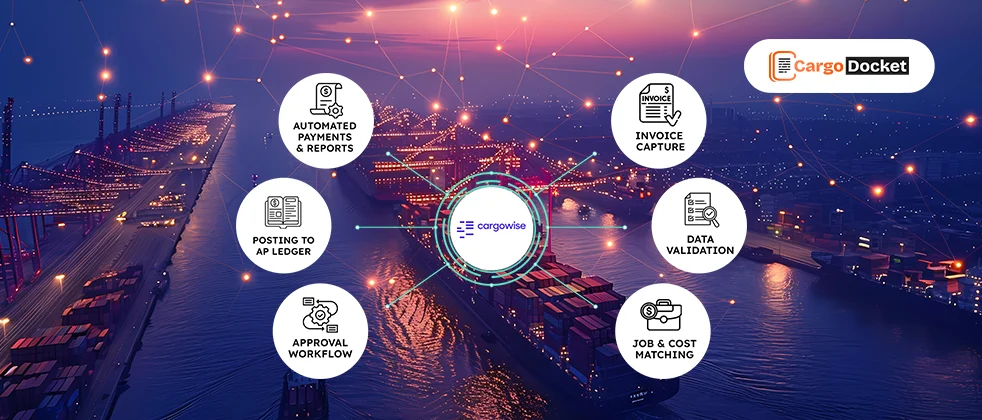
AI-powered document automation reads invoices directly from emails or shared folders. It extracts key data fields such as supplier details, charge lines, references, amounts, and currencies.
That data is then validated against CargoWise records, including accruals, jobs, charge codes, and internal business rules. If everything matches, the invoice is prepared for posting automatically. If something doesn’t align, the system flags it as an exception for review.
This approach ensures only clean, accurate data enters CargoWise while keeping finance teams firmly in control of final decisions.
Best Practices for Implementing AP Automation
Successful automation starts with understanding existing AP workflows. Identifying where delays and errors occur helps ensure automation addresses real pain points.
Rolling out automation in phases is also important. Starting with high-volume or repetitive invoices allows teams to build confidence before expanding to more complex scenarios.
Most importantly, collaboration between finance, operations, and IT ensures automation supports business goals rather than disrupting them.
Common Challenges Teams Face During AP Automation
Automation is not a “set and forget” solution. One common mistake is assuming automation removes the need for human oversight. In reality, it removes manual data entry effort, not accountability.
Another pitfall is poor data quality. Automation quickly exposes inconsistencies in charge codes, vendor records, or accruals. While this can feel uncomfortable initially, it ultimately leads to cleaner data and stronger controls.
Finally, skipping training can limit adoption. Teams need to understand how automation supports their work and how to respond to exceptions effectively.
Conclusion
Accounts payable automation is no longer optional for logistics teams operating in CargoWise. It brings structure, consistency, and confidence to one of the most critical financial workflows in freight operations.
By automating invoice capture, validation, and posting, businesses reduce errors, improve visibility, strengthen compliance, and free finance teams to focus on what truly matters.
CargoDocket integrates AI document automation directly with CargoWise, ensuring invoices are validated line by line and posted accurately without manual intervention. If you’re ready to reduce AP friction, improve financial control, and give your finance team room to breathe, book a free demo and see how automation can transform your Accounts Payable workflow.