
Every international shipment carries two kinds of weight, the physical cargo and the paperwork that keeps it moving. Among all freight documents, the Bill of Lading sits right at the center of global trade. It ties together contracts, customs, billing, compliance, and customer confidence.
For CargoWise users, the challenge isn’t understanding what a Master Bill of Lading or a House Bill of Lading is. The real friction starts when teams manually break down one MBL into multiple HBLs, retype the same data repeatedly, wait for last-minute carrier updates, and correct inconsistencies after documents are already issued.
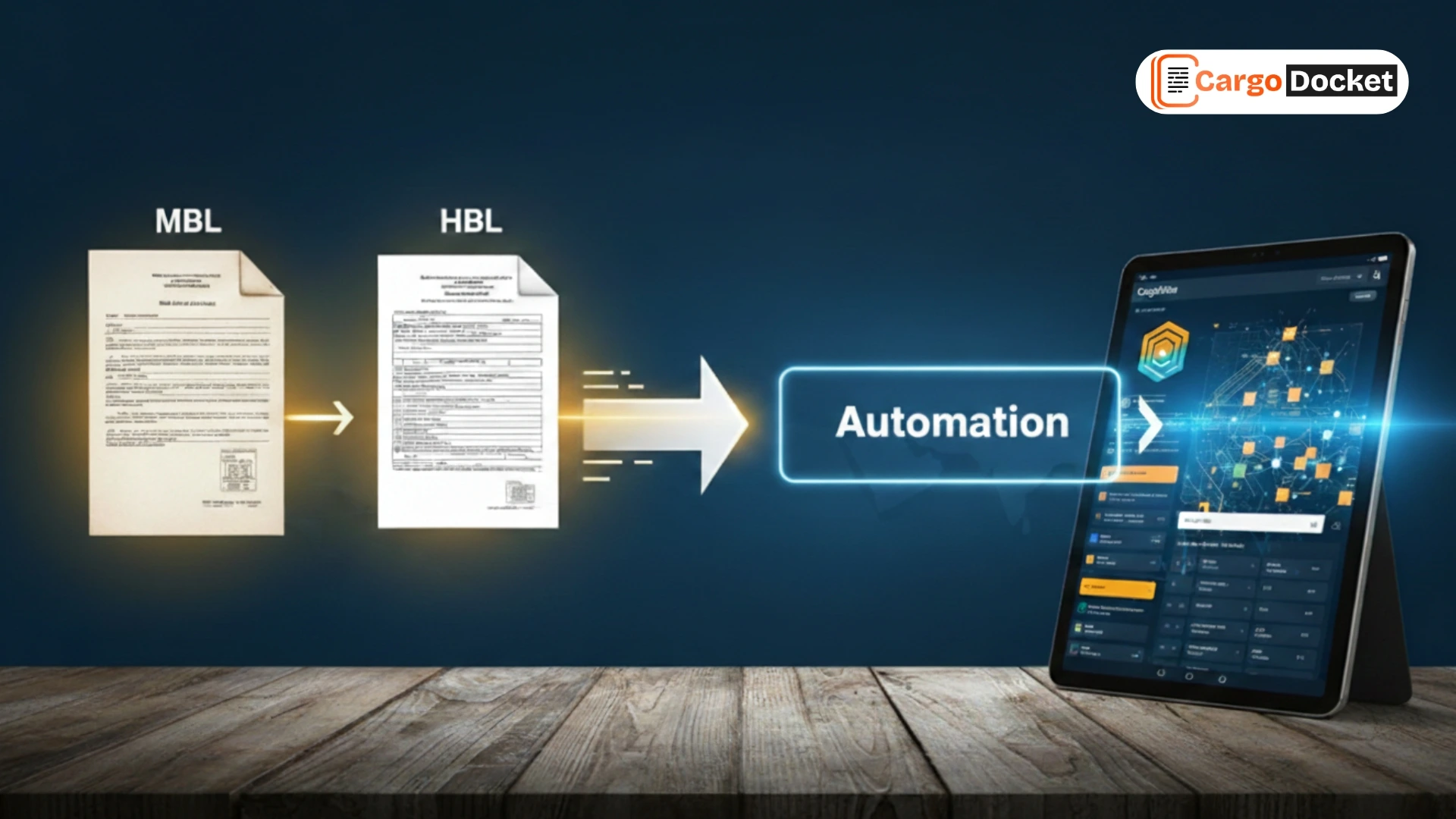
That’s exactly where automation makes a difference. When the MBL-to-HBL process is automated inside CargoWise, documentation stops slowing operations down and starts supporting faster, cleaner, and more reliable workflows.
Let’s look at how this shift works and why forwarders are moving away from manual Bill of Lading management.
Understanding How MBL and HBL Drive Freight Operations
The relationship between MBL and HBL is foundational to freight forwarding, especially in consolidated shipments.
The Master Bill of Lading (MBL) is issued by the ocean carrier or NVOCC to the freight forwarder. It represents the carrier’s contract of carriage for the entire consolidated shipment and includes vessel details, voyage numbers, ports, container information, and sailing dates. At the destination, the MBL plays a key role in carrier release and customs processing.
The House Bill of Lading (HBL) is issued by the freight forwarder to individual customers. Each HBL reflects customer-specific shipment details, shipper and consignee information, cargo descriptions, and freight charges. A single MBL can support many HBLs, especially in LCL or consolidation scenarios.
Because these documents are tightly connected, even a small mismatch between an MBL and its related HBLs can affect operations, finance, and compliance at the same time.
Why Manual MBL-to-HBL Processing Puts Forwarders at Risk?
In many forwarding offices, the MBL-to-HBL workflow still relies heavily on spreadsheets, copy-paste routines, and email confirmations. While this approach might work at low volumes, it quickly breaks down as shipment counts grow.
Manual processing creates repeated data entry across documents, vessel names, container numbers, routing details, weights, and dates are typed multiple times. Every re-entry increases the risk of errors, whether it’s a wrong container number, incorrect port code, or outdated sailing information.
From an operational standpoint, teams can spend several hours per shipment creating and checking HBLs, time that should be spent managing exceptions, customers, or capacity planning. From a compliance angle, inconsistent documentation raises audit risks and increases the chance of customs delays.
When MBL updates arrive late, which is common, teams are forced into reactive corrections, reissuing HBLs, and manually notifying customers. The process becomes stressful, inefficient, and difficult to scale.
How Automation Changes the MBL-to-HBL Equation in CargoWise?
Automation inside CargoWise removes this friction by allowing data to flow logically instead of being retyped repeatedly.
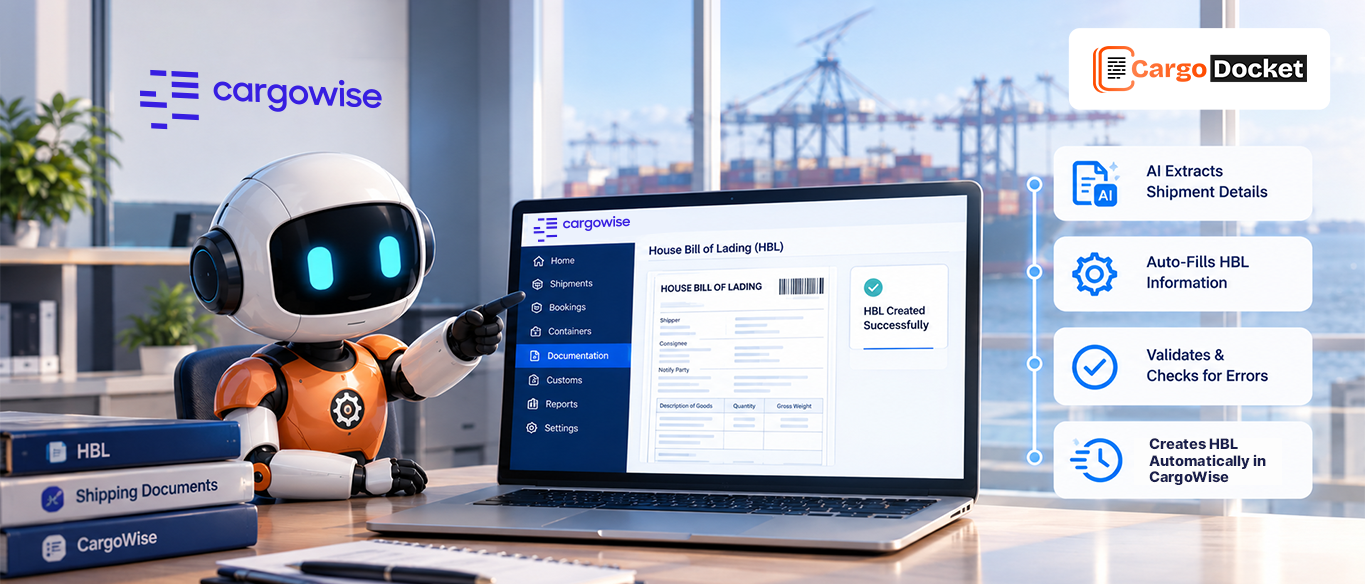
When an MBL is created or updated, CargoWise can automatically push core shipment data, vessel details, voyage numbers, routing, container information, and schedules into all related HBLs. This ensures consistency across documents and eliminates duplicate data entry.
At the same time, the system allows forwarders to maintain flexibility. Customer-specific details such as consignee information, cargo descriptions, and commercial terms can still be handled at the HBL level without disrupting the inherited shipment data.
Most importantly, when changes occur at the MBL level, automation ensures those updates are reflected across every connected HBL in real time, with no manual rework, no missed amendments, and no version confusion.
What Benefits do Forwarders Gain from Automating MBL-to-HBL in CargoWise?
Once automation is in place, the operational impact becomes clear very quickly. Forwarders experience measurable improvements across speed, accuracy, and team efficiency.
Key benefits include:
- Faster creation and release of HBLs from a single MBL
- Significant reduction in manual data entry and duplication
- Fewer document amendments caused by mismatched shipment details
- Improved consistency across customer-facing documentation
- Better control over high-volume consolidation workflows
Instead of spending hours building and checking documents, teams gain time back to focus on exceptions, customer service, and shipment execution.
How does Automation Strengthen Accuracy and Compliance?
Automation helps forwarders maintain documentation accuracy while meeting compliance requirements without adding extra effort.
Aligned MBL and HBL data
Any update made to the Master Bill of Lading automatically flows into all related House Bills. This keeps vessel, routing, and container details consistent across every document.
Reduced compliance risk
Standardized data validation ensures required fields are always populated correctly. This minimizes customs delays, inspections, and penalties caused by inconsistent documentation.
Built-in audit visibility
Every change to a Bill of Lading is automatically logged within CargoWise. Teams can quickly trace document history without searching emails or spreadsheets.
Faster inspections and approvals
Clean, synchronized documents reduce back-and-forth during customs or internal reviews. Approvals move faster because data is already aligned and verified.
Greater confidence before release
Teams can issue Bills of Lading, knowing the information is current and accurate. This reduces last-minute corrections and post-release amendments.
How does Automation Help Operations Scale Without Adding Complexity?
Growth exposes weaknesses in manual processes very quickly. As shipment volumes increase, documentation teams often feel the pressure first. Automation changes that equation.
When MBL-to-HBL workflows are automated, forwarders can handle more shipments without increasing headcount. The system absorbs the repetitive work, copying data, checking fields, and updating documents, so people don’t have to. That shift allows experienced staff to focus on exception management, customer communication, and service quality rather than routine paperwork.
The result is a calmer, more predictable operation. Peak seasons become manageable. Staff burnout drops. And operational resilience improves, even when schedules change or carrier updates arrive late.
Conclusion
The transition from Master Bill of Lading to House Bill of Lading has long been one of the most time-consuming parts of freight documentation. But it doesn’t have to stay that way.
By automating the MBL-to-HBL process in CargoWise, forwarders replace manual effort with consistency, speed, and control. Documents move faster, errors decrease, compliance becomes easier, and teams gain the breathing room they need to operate confidently at scale.
In an industry where margins are tight and expectations are high, automation isn’t just about efficiency, it’s about staying competitive.
Ready to move beyond manual Bill of Lading workflows? See how intelligent automation can transform your CargoWise operations and turn documentation into a strength instead of an obstacle. Book a demo today to see how intelligent automation can simplify your CargoWise environment and turn Bill of Lading management into a true operational advantage.