

Getting a customer invoice paid is not always as straightforward as sending it. As a freight forwarder, you may need to pay carriers, shipping lines, and other service providers before receiving payment from your customers. When those payments are delayed, your business can face pressure on its working capital.
You might already have an accounts receivable aging report showing which customers have outstanding invoices. But does that report tell your team which invoices need attention today, who is responsible for following up, or how much money you are likely to collect this month?
This is where AR aging and Days Sales Outstanding (DSO) tracking become useful. They help you understand your outstanding receivables, identify collection risks, and monitor how effectively your team is collecting payments.
Let’s look at how you can use these metrics to improve customer collections and manage your receivables more effectively in CargoWise.
What do AR Aging and DSO Tell You About Your Outstanding Payments?
AR aging and DSO help you understand two important aspects of your accounts receivable process: how long invoices have remained unpaid and how quickly your business collects customer payments.
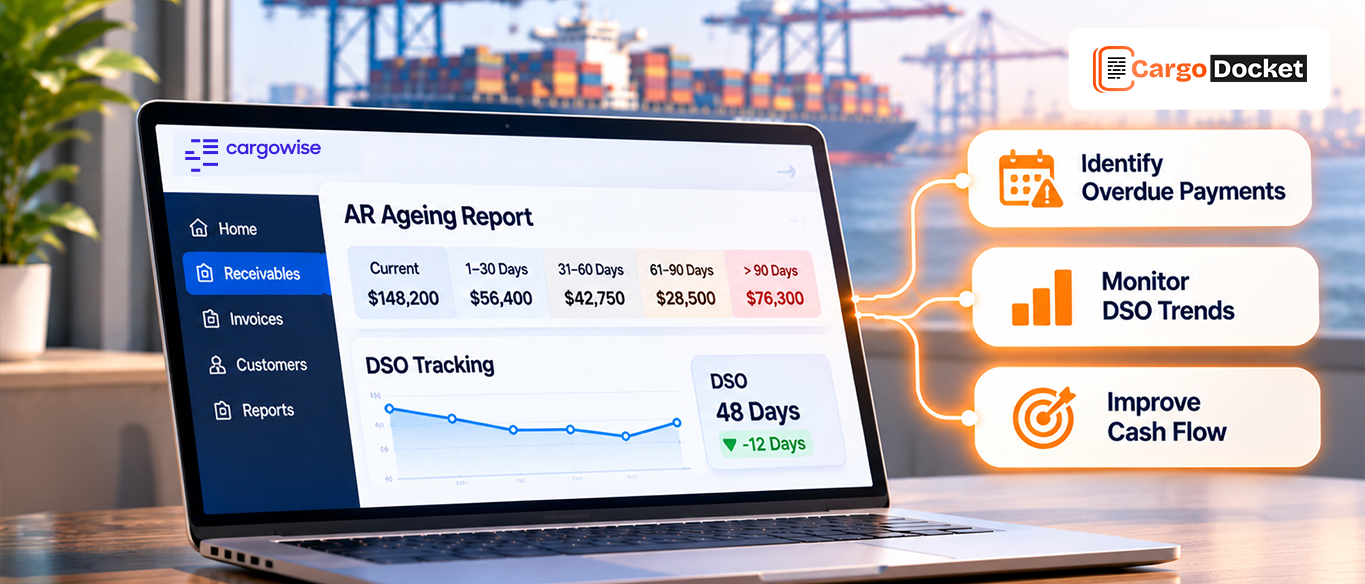
AR Aging groups outstanding customer invoices based on how long they have been unpaid. Common aging categories include:
- Current: Invoices that are not yet due.
- 1–30 days: Invoices overdue by up to 30 days.
- 31–60 days: Invoices overdue by 31 to 60 days.
- 61–90 days: Invoices overdue by 61 to 90 days.
- 90+ days: Invoices that have remained unpaid for more than 90 days.
This breakdown helps your finance team identify overdue payments and understand where outstanding balances are building up.
Days Sales Outstanding (DSO) measures the average number of days your business takes to collect payment after making a credit sale. A rising DSO may indicate that customers are taking longer to pay, while a falling DSO can indicate faster collections.
For example, if your DSO increases from 45 to 60 days, it means your business is taking longer to convert credit sales into cash. Monitoring this trend helps you identify potential collection delays before they create greater cash flow pressure.
Why are Freight Forwarders Struggling to Collect Customer Payments on Time?
Freight forwarding involves several operational and financial activities, and customer collections can become difficult when follow-ups are not properly organized.
You may have hundreds of outstanding invoices across different customers, branches, and shipments. Tracking each payment manually becomes difficult, especially when your team relies on spreadsheets, email reminders, and separate aging reports.
Consider a few common challenges:
Delayed customer follow-ups: Your team may identify overdue invoices but miss follow-up dates because reminders and payment commitments are tracked manually.
Unclear invoice ownership: When multiple collectors handle customer accounts, it may not always be clear who is responsible for contacting a customer or resolving a payment issue.
Missed payment commitments: A customer may promise to pay by a particular date, but without proper tracking, the commitment can easily be overlooked.
Limited collection visibility: An aging report shows outstanding balances, but it does not necessarily show how much your team has collected against its target or whether the collection cycle is on track.
These problems make it harder to understand your actual collection position and plan your next actions.
How can You Use AR Aging and DSO to Identify Customers Who Need Follow-Up?
Having an aging report is useful, but the real value comes from knowing what action to take based on the information.
Start by reviewing your outstanding invoices by aging category. This helps you identify customers with overdue balances and determine which payments require immediate attention.
For example, a customer with several invoices overdue by more than 60 days may need closer attention than a customer whose invoice became overdue yesterday.
You can also use DSO trends to understand whether your collection performance is improving or declining. If DSO continues to increase, review which customers, branches, or outstanding balances are contributing to the delay.
Your finance team can use these insights to:
- Prioritize invoices with older or higher outstanding balances.
- Identify customers with repeated payment delays.
- Review disputed invoices separately from regular overdue payments.
- Monitor changes in DSO across branches.
- Plan follow-ups based on payment commitments and invoice status.
The goal is not simply to identify overdue invoices. It is to help your team decide which customer to contact, what needs attention, and what action should happen next.
How can You Turn Outstanding Invoices into a Structured Collection Process?
Once you identify which invoices need attention, the next step is to organize the collection work. Instead of allowing collectors to manage follow-ups independently through spreadsheets and emails, establish a clear process where every invoice has an owner, a next action, and a follow-up history.
For example, your collection manager can set a target for a collection cycle and assign outstanding invoices to individual collectors. Each collector then follows up with customers, records payment commitments, and updates the status of each invoice.
You can also monitor daily collection progress against the target.
Suppose your team has a collection target of $4 million for the current cycle and has collected $1.45 million so far. With $2.55 million remaining and 18 days left, the team needs to collect approximately $141,667 per day to reach its target.
This gives your finance manager a clearer picture of the work ahead. If collections fall behind the expected progress, the team can identify the risk and take action rather than waiting until the end of the month.
A structured collection process helps your team move from simply reviewing outstanding balances to actively managing customer payments.
How does CargoDocket Help You Manage AR Collections in CargoWise?
If your team already manages financial operations in CargoWise, you need a collection process that connects with your existing receivables information.
CargoDocket’s AR Collection Tool brings open receivables and customer information from CargoWise into a structured collection workflow. It helps your finance team manage invoice follow-ups, assign responsibilities, track collection targets, and monitor payment progress.
Here’s how it supports your collection process:
1. View outstanding invoices by aging.
Bring open receivables from CargoWise into an invoice backlog grouped by customer and aging category. Your team can filter invoices by customer, status, amount, and age to identify which balances need attention.
2. Set collection targets and manage cycles.
Your collection manager can establish a collection target at the beginning of each cycle and select the invoices the team needs to work on. This gives everyone a clear collection goal.
3. Assign invoice owners and track follow-ups.
Assign each open invoice to a collector and record calls, emails, payment promises, and the next action. This makes responsibilities clearer and helps prevent customer follow-ups from being missed.
4. Monitor collection progress with a burndown dashboard.
Track the amount collected against the collection target and monitor daily progress. The dashboard highlights whether the team is on track, at risk, or behind its expected collection progress.
5. Monitor AR and DSO performance
Review collection metrics such as collected versus target, amount needed per day, aging split, cycle success rate, collector performance, and DSO trends by branch over time.
6. Give customers a payment portal.
Customers can view open and overdue invoices, check payment history, and make payments through supported online payment options. Partial payments are reflected in collection progress, helping your team maintain better visibility.
With scheduled receivables synchronization and automatic payment updates back to CargoWise, CargoDocket helps your team manage collections without relying entirely on separate spreadsheets and manual updates.
Improve Your Customer Collections with Better AR Visibility
Knowing which customers owe you money is only the starting point. You also need to understand which invoices require attention, who is responsible for following up, and whether your team is moving toward its collection target.
By combining AR Aging, DSO tracking, and a structured follow-up process, you can improve visibility into outstanding receivables and manage collections with greater accountability.
Looking to bring more structure to your CargoWise collections process? Contact us to see how our AR Collection Tool can help your team manage receivables and improve collection visibility.