
A bank statement can look simple at first glance, but then you open it and find hundreds of transactions, different descriptions, bank charges, missing entries, and payments that don’t immediately line up with your financial records.
That’s where reconciliation starts taking time.
As transaction volumes grow, manually matching every bank transaction with the right accounting record can become repetitive and slow. CargoDocket AI can help take on much of this matching work while leaving your finance team to focus on the transactions that actually need attention.
What is Bank Reconciliation and Why does it Matter?
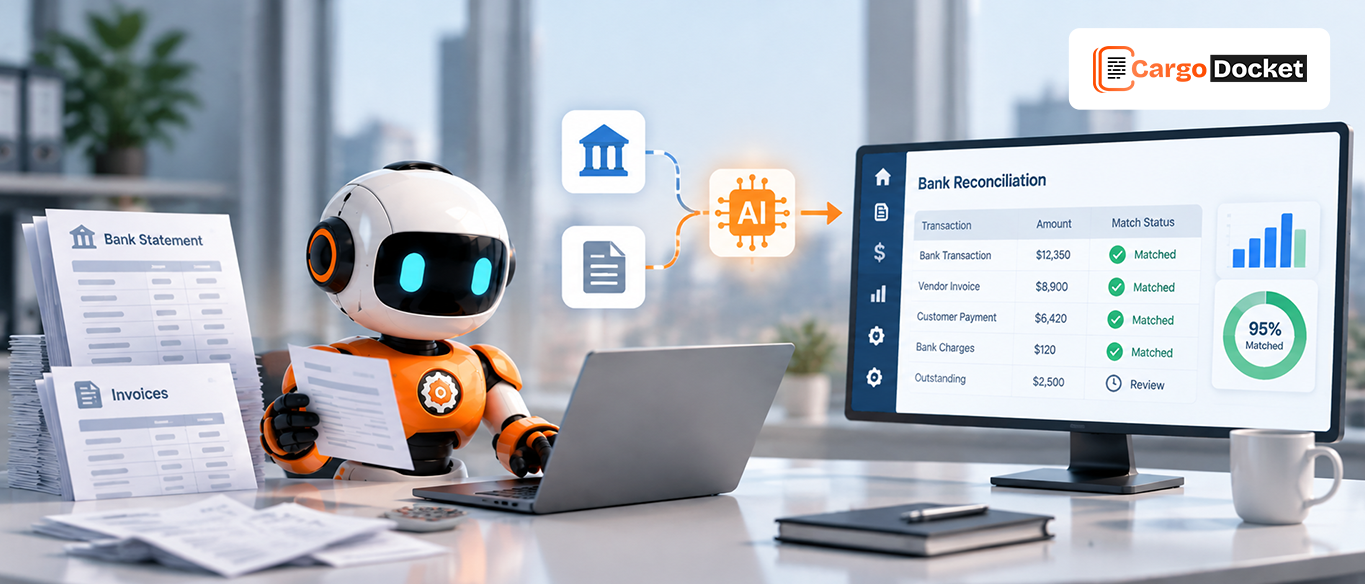
Bank reconciliation is the process of comparing bank statement transactions with the corresponding records in your financial system. It helps identify differences and make sure your financial records accurately reflect actual bank activity.
For example, your bank statement may show a $2,500 payment, while your accounting records contain several transactions that could relate to it. Your team needs to find the right transaction, confirm the details, and reconcile it.
Regular reconciliation can help your team:
- Keep financial records accurate and complete
- Identify missing or duplicate transactions
- Find unexpected differences
- Support financial reporting and audits
- Maintain a clearer view of cash activity
The challenge is that the number of transactions can grow much faster than the time available to review them manually.
Why does Manual Transaction Matching Become Difficult?
The real problem isn’t matching one transaction. It’s doing the same thing hundreds of times.
A bank statement may use a different description from the accounting record. One payment may cover multiple invoices, or several transactions may need to be considered together.
Your finance team may have to compare:
Amount → Date → Description → Reference → Customer/Vendor → Related Records
Then they need to decide whether the transaction is a match or an exception.
When this process is repeated across multiple accounts, it can slow down reconciliation and add unnecessary work during month-end close.
Who can Benefit From Bank Reconciliation Automation?
Automation can be useful for businesses where transaction volumes or financial complexity are growing.
You may want to consider automation if your team:
- Manages multiple bank accounts
- Regularly handles unmatched transactions
- Spends significant time on manual transaction matching
- Experiences delays during month-end close
- Needs stronger consistency and financial controls
You don’t have to be a large enterprise to benefit. Even a growing finance team can save considerable time when routine reconciliation tasks are automated.
How can AI Extract and Understand Bank Transaction Data?
Before transactions can be matched, the information needs to be captured and structured.
Bank statements and supporting financial documents can come in different formats. AI can help read these documents and extract important information such as
Transaction Date | Description | Amount | Reference | Transaction Type
Instead of manually entering these details, AI can organize the information so it can be used in the reconciliation workflow.
This becomes especially useful when your team receives large numbers of statements or documents that would otherwise require repetitive data entry.
How can AI Match Bank Transactions With Accounting Records?
Once the transaction data is structured, AI can look for corresponding records in the financial system.
For example:
Bank Transaction:
$1,250 — ABC Logistics — Sept. 15
Accounting Record:
$1,250 — ABC Logistics Invoice — Sept. 15
The amount, date, and description provide useful signals for identifying the match.
In reality the transactions are not always so clean. A single bank payment can cover a number of invoices or the description of the transaction can be shortened.
Instead of exact description or amount, artificial intelligence can look at several data The amount, date, and description are useful clues to help in identifying the match.
What Happens When a Transaction doesn’t Match?
Not every transaction should be automatically reconciled.
If the amount is different, the reference is missing, or multiple possible matches exist, the transaction can be flagged as an exception.
For example:
Bank Transaction: $5,000
Possible Records: $3,000 + $2,000
Rather than forcing a match, the system can bring the transaction to the finance team’s attention.
This creates a practical workflow:
AI Finds Potential Match → Automation Handles Routine Cases → Differences Are Flagged → Finance Team Reviews Exceptions
That keeps people involved where financial judgment is needed.
How does Automation Make Reconciliation Easier?
The biggest benefit is simple: your team doesn’t have to manually check everything.
An automated workflow can look like:
Bank Statement Received → Data Extracted → Transactions Matched → Differences Identified → Exceptions Flagged → Human Review → Reconciliation
This can help reduce repetitive work, improve consistency, and allow finance teams to spend more time investigating important exceptions instead of searching for routine matches.
What should You Consider Before Automating?
AI works best when the reconciliation process has clear rules.
Before automating, consider:
- Which transactions can be matched automatically?
- What differences require review?
- Which transactions need approval?
- How should unmatched transactions be handled?
- How will reconciliation activity be tracked?
The goal isn’t to remove people from the process. It’s to let automation handle the repetitive work while your team handles the decisions that require context.
How can AI Document Automation Support Bank Reconciliation?
AI Document Automation can support the process before transaction matching even begins. It can help process bank statements and supporting financial documents, extract relevant information, structure the data, and prepare it for matching and reconciliation.
Conclusion
Bank reconciliation doesn’t have to mean manually checking every transaction. AI can help extract data, identify potential matches, and surface exceptions while your finance team stays in control of important decisions.
With AI Document Automation, businesses can reduce repetitive document and transaction work and make reconciliation easier to manage.
Ready to reduce manual transaction matching? Contact us to see how AI Document Automation can help streamline your reconciliation workflow, identify exceptions faster, and give your finance team more time for higher-value work.