
“Another invoice to retype. Another customs document to upload. Another packing list to validate line by line.”
Sound familiar? That’s still the daily grind for many logistics teams. But it doesn’t have to be.
The way logistics companies handle documents is changing fast, and not just because they want to, but because they have to. High shipment volumes, global compliance requirements, workforce constraints, and rising customer expectations are pushing freight forwarders, customs brokers, and 3PLs toward smarter, more scalable systems. At the center of this shift? Document automation.
Let’s break down why this evolution is happening, how it works today, and what it means for the future of logistics operations.
Why was Document Handling Such an Obstacle in Logistics?
To understand where we’re going, it helps to know where we’ve been.
Historically, logistics has always been a paper-heavy industry. Think about all the forms involved in even a single shipment, commercial invoices, house bills of lading, master bills, packing lists, delivery receipts, customs clearance documents, vendor invoices… the list goes on.
While many documents are now emailed rather than printed, the actual handling hasn’t changed much. Teams still spend hours every day:
- Downloading and reviewing PDFs
- Manually entering data into systems like CargoWise
- Verifying figures and codes against shipment records
- Uploading eDocs for compliance and billing purposes
The result? Human errors, processing delays, frustrated teams, and higher costs.
What Sparked the Shift Toward Automation?
A few years ago, basic OCR (optical character recognition) tools entered the scene, promising to eliminate manual typing. But these tools were rigid, often struggling with non-standard formats. Logistics, with its diverse document styles, wasn’t a great fit for high-risk OCR.
Then AI got smarter.
Machine learning models began to learn from variations, detect patterns in invoices, map fields across different layouts, and even classify documents without being told. This ability to understand unstructured data, not just scan it, changed the game.
Now, AI-powered automation tools can do things that were once impossible:
- Extract line-item details from inconsistent formats
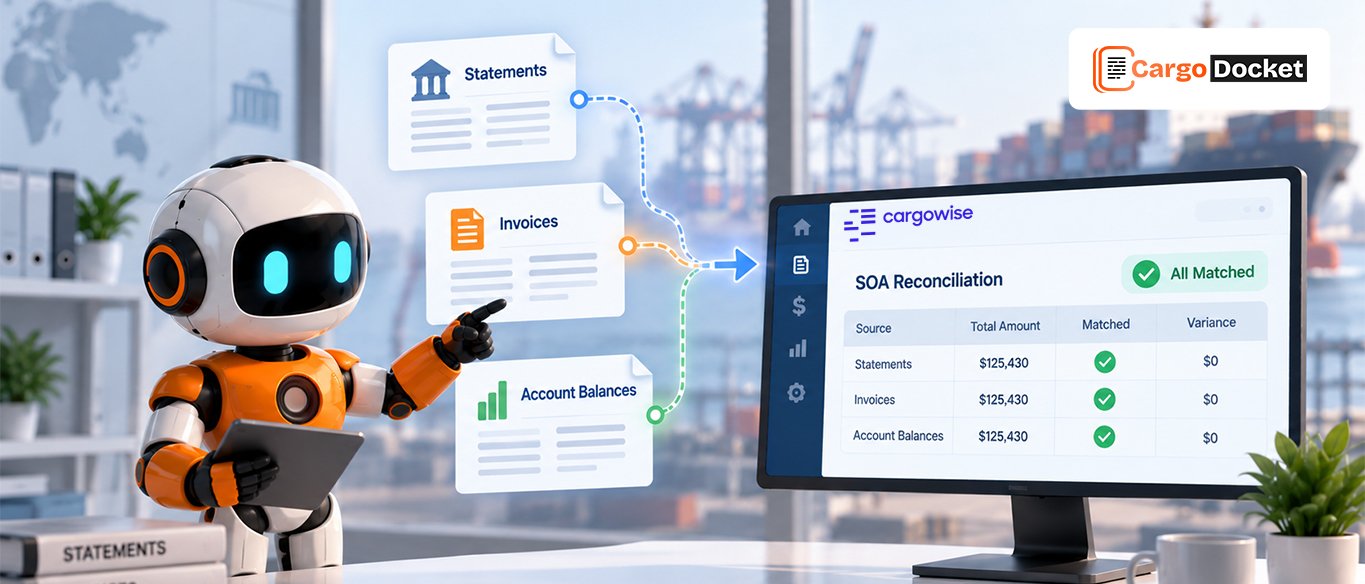
- Validate data against shipment records in real-time
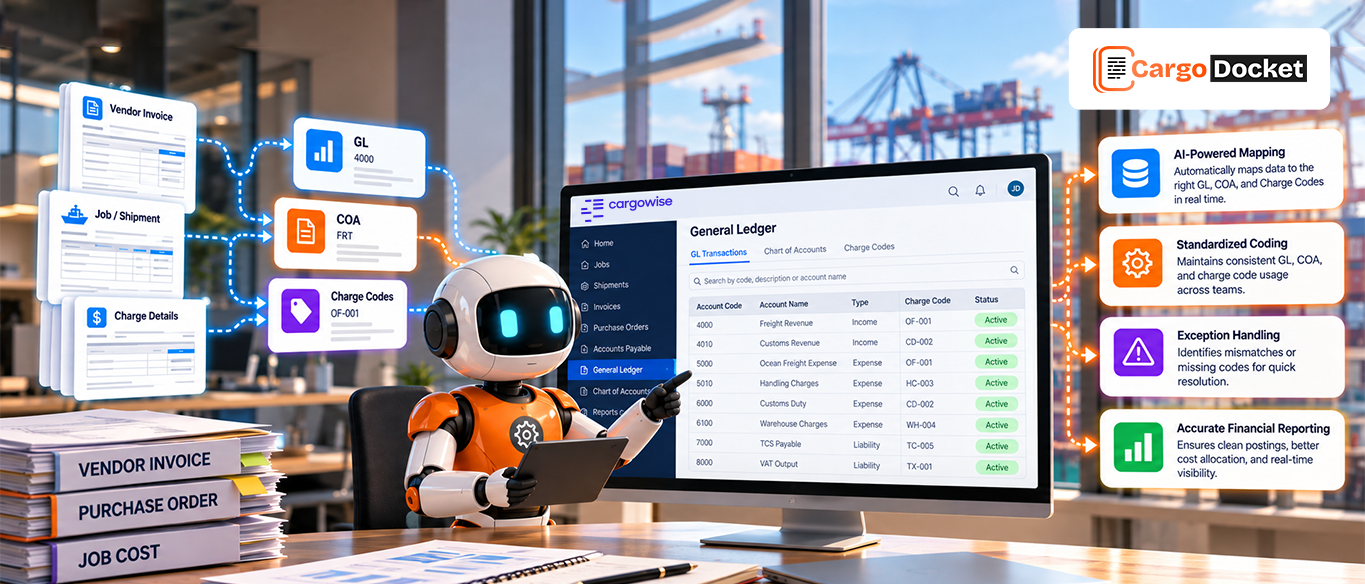
- Auto-post charges, upload documents, and flag exceptions
- Continuously learn from corrections and new templates
That’s the kind of shift that goes beyond productivity. It’s a strategic transformation.
What Does Modern Document Automation Actually Look Like?
Let’s say your team receives a commercial invoice via email. Here’s what happens with the right automation in place:
The system scans your shared inbox for new attachments (PDF, image, Excel).
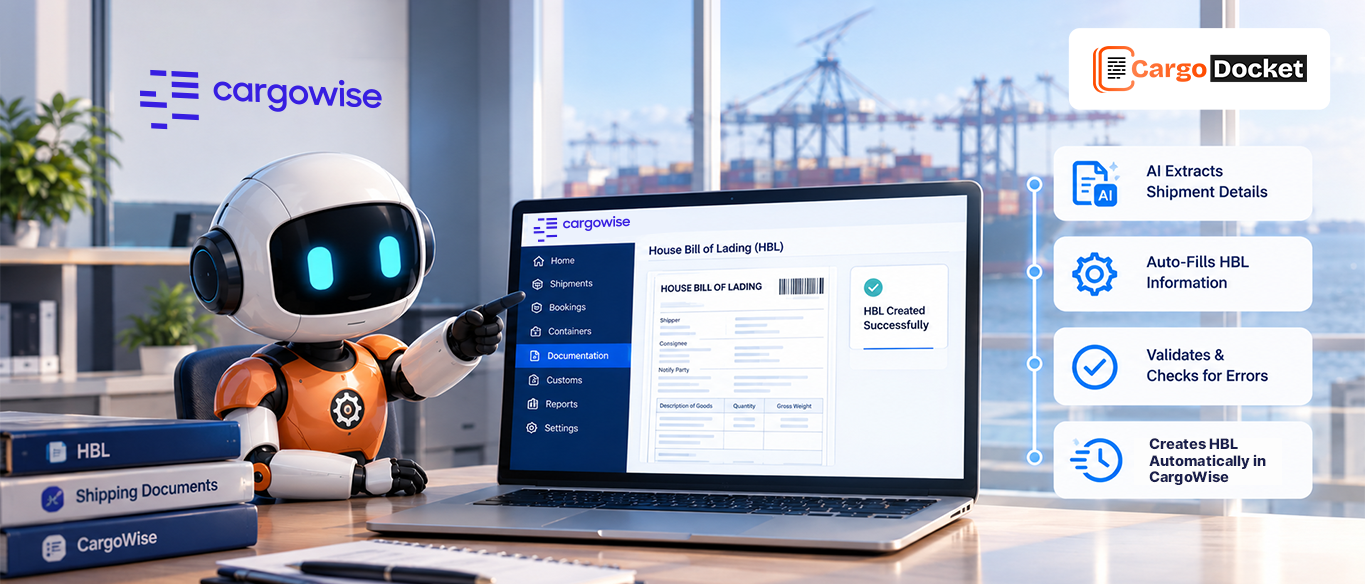
AI reads the document, identifies what type it is, and extracts the key data points, consignee, container numbers, freight charges, tariff codes, etc.
It cross-checks the extracted data against your CargoWise shipment record. Any mismatch? It flags it.
If everything checks out, it automatically uploads the document and posts the relevant data, no manual entry, no wasted time.
This workflow is repeated across all kinds of documents: packing lists, bills of lading, AP invoices, customs declarations, and even emails with embedded data. Instead of relying on a person to interpret and re-enter every detail, the system does the heavy lifting. The person just reviews the outliers.
How is This Solving Real Problems for Logistics Teams?
Here’s what logistics operations teams are saying after adopting AI document automation:
“We cut our document processing time by more than half.”
“Our staff can now focus on managing shipments, not managing PDFs.”
“The billing errors dropped by 62% in the first two months.”
And it’s not just about speed, it’s about visibility, control, and scalability. Some key benefits include:
Faster job closure: With documents processed quickly, jobs can be invoiced and closed sooner.
Fewer reworks: Data validation at the point of capture reduces corrections later.
Improved vendor relationships: Timely invoice matching = timely payments.
Easier audits: Every step is logged and traceable, meeting strict compliance needs.
Where Does CargoWise Fit Into This Evolution?
CargoWise is the nerve center of many freight forwarding operations. But when it comes to document handling, its efficiency depends heavily on what data it receives and how quickly it gets there.
That’s where automation tools like Cargo Docket AI step in. These systems work alongside CargoWise to:
- Feed it clean, validated data from incoming documents
- Trigger workflows automatically based on extracted details
- Reduce the number of manual touchpoints required to process jobs
Instead of your team logging in and entering details manually, they spend their time reviewing exceptions, managing vendor communication, and delivering better service to clients. That’s how automation turns a legacy obstacle into a modern advantage.
Who Should Be Prioritizing Document Automation Right Now?
Honestly? Any freight forwarder, 3PL, or customs broker handling more than 50 shipments a month should be exploring document automation. That includes:
- Operations teams dealing with backlogs and data entry
- Accounting teams are matching hundreds of vendor invoices
- Customs brokers handling documents with line-item HS codes
- Small teams that want to scale up without hiring more admin staff
Whether you’re handling local trucking or global ocean freight, the volume of documents is only going up. Automation isn’t optional anymore, it’s how you stay competitive.
What’s Coming Next in Document Automation?
We’re already seeing exciting developments:
Automated response generation: Systems that not only process a vendor’s invoice but also reply with a remittance.
Real-time collaboration features: So that teams across countries can view, comment, and act on a document together.
Voice-driven document search: Think of asking your system, “Show me all packing lists missing container numbers this week.”
These aren’t far-off ideas. They’re being piloted right now by modern logistics tech providers.
Conclusion
Every hour your team spends re-entering data from documents is an hour they could be using to move freight, close jobs, or serve clients. AI-driven document automation is no longer simply a term, it’s the backbone of scalable, modern logistics.
And the best part? You don’t have to overhaul your systems to make it happen. With platforms like CargoDocket, you can keep using your CargoWise setup, just accelerated with automation.
Let us show you how. Book a free demo today and see what automated document handling can do for your business.