
Freight documents arrive via email every day, but the information contained within them often takes much longer to reach CargoWise. Commercial invoices, bills of lading, air waybills, and packing lists still require manual reading, validation, and data entry.
AI Document Automation is transforming the process, converting incoming attachments into validated, CargoWise-ready data with fewer manual steps and faster processing.
📥 What Happens to Freight Documents Between Your Inbox and CargoWise?
When a bill of lading, commercial invoice, or air waybill lands in your inbox, the document has arrived, but its data has not yet made its way to your operation.
Someone usually has to open the attachment, figure out what type of document it is, find the shipment information they need, verify that information, and input it into CargoWise.
Now multiply that process by hundreds of emails.
Documents could come from customers, carriers, suppliers, and overseas agents, each with a different layout and file format. Your ops team needs to deal with those differences while managing shipments at the same time.
This creates a gap between the time the document is received and when the information is available in CargoWise. That gap is increasingly difficult to bridge as more documents are created.
⚠️ Why Email-Based Document Processing Slows Down Freight Operations?
The inbox itself isn’t the problem. It’s all the manual work that happens after an email arrives.
When your team is the link between email attachments and CargoWise, every document is another manual task. Those tasks can pile up quickly during busy periods.
Common challenges include:
- Data entry delays: Documents can sit in shared inboxes until somebody gets around to processing them.
- Manual work repeated: Teams repeatedly download, read, copy, validate, and enter information.
- Data-entry errors: Shipment references, weights, quantities, invoice values, or customer information can be entered incorrectly.
- Slower downstream processes: data needed for bookings, customs activities, billing, and other workflows may have to wait.
- Limited scalability: Increased shipment volumes typically result in more documents and more manual work.
Five minutes on its own might not sound like much. But repeat it hundreds of times, and it becomes a real operational workload. This is where AI starts to change the process.
🤖 How AI Turns Incoming Freight Documents into CargoWise-Ready Data?
Instead of waiting for a person to process each attachment, artificial intelligence can begin work immediately upon receipt of the document.
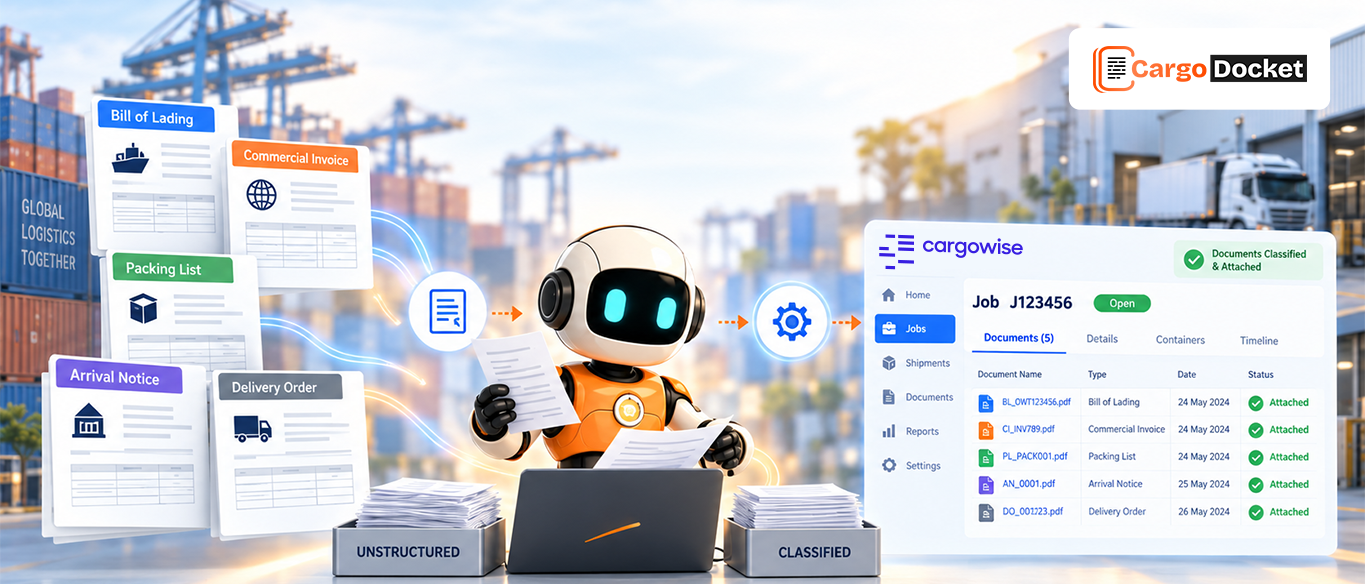
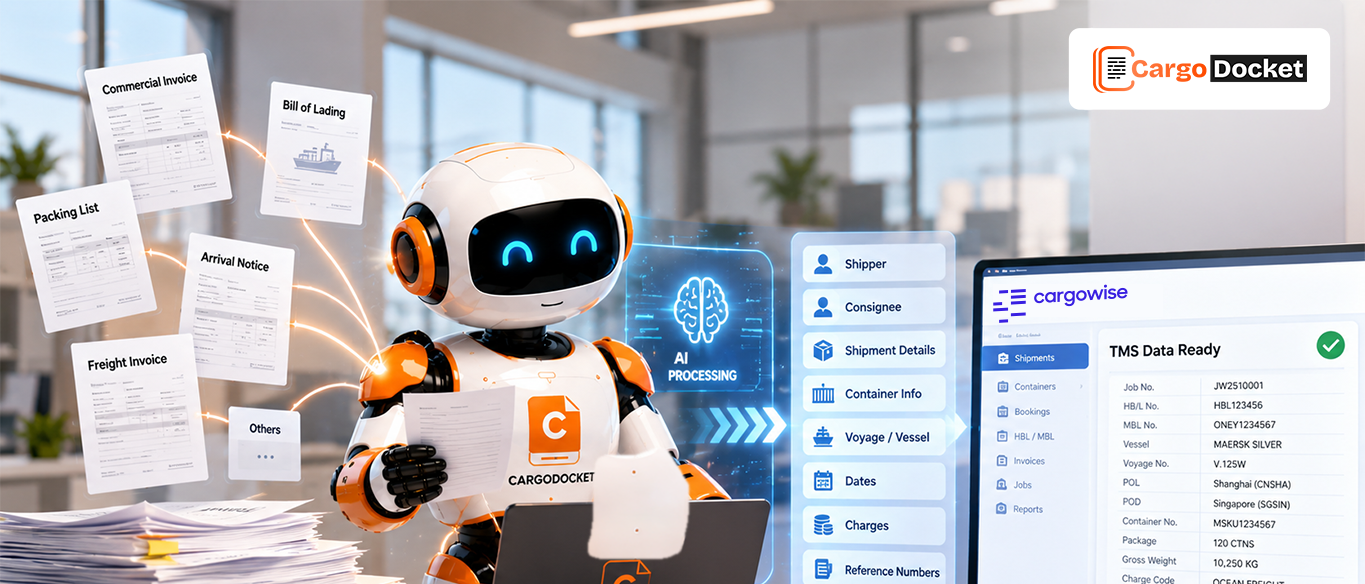
First, it recognizes what has come. It may identify a commercial invoice, bill of lading, air waybill, packing list, shipping instruction, or other freight document. It then reads the document and pulls out the information needed for the relevant CargoWise workflow.
Artificial intelligence can, for instance, capture shipment references, shipper and consignee information, invoice numbers, values, quantities, weights, ports, container information, and other operational fields.
But extraction alone won’t do. The information must be correctly structured, checked and prepared for the relevant fields in CargoWise.
That’s the key difference. The goal isn’t simply to read a PDF faster, it’s to turn the information inside that document into data your logistics operation can actually use.
🔄 How the Automated Workflow Moves Documents from Email to CargoWise?
Once the process is automated, the journey from inbox to CargoWise becomes much more straightforward.
1. Receive the document
Freight documents arrive through the designated email inbox and enter the processing workflow automatically.
2. Read and extract the data
AI identifies the document type and captures the required shipment, customer, financial, or operational information.
3. Map and prepare the information
Extracted information is structured and mapped to the appropriate CargoWise fields and workflow.
4. Validate the data
The information is checked against defined business rules, required fields, and available reference data.
5. Manage exceptions
If information is missing, inconsistent, or uncertain, the document is flagged for review rather than automatically moving forward.
6. Send validated data to CargoWise
Once the information passes validation, it can be transferred into the relevant CargoWise process.
In simple terms:
Email received → Document read → Data extracted → Data validated → Exceptions reviewed → Data sent to CargoWise
Your team no longer needs to manually process every document. Their attention can shift toward the exceptions that genuinely require logistics knowledge and judgment.
🛡️ How AI Validates Data and Manages Exceptions Before it Reaches CargoWise?
Getting information into CargoWise quickly matters, but getting the right information there matters even more. Suppose a commercial invoice contains the invoice number, value, and customer information, but the shipment reference is missing. Instead of sending incomplete data into CargoWise, the workflow can identify the problem and hold that document for review.
AI-driven validation can help identify issues such as:
- Missing required information
- Duplicate documents
- Mismatched shipment references
- Unexpected or inconsistent values
- Low-confidence extracted fields
- Information that doesn’t meet predefined business rules
Clean data can continue through the workflow, while exceptions are directed to the appropriate employee.
This creates a practical balance between AI and human expertise. Your team still controls the process, but instead of checking every routine document, they can focus on the cases where their experience actually adds value.
🚀 What Changes When Freight Documents No Longer Wait in the Inbox?
Removing the manual gap between email and CargoWise can have a wider impact than simply saving document-processing time.
When information becomes available sooner, the processes that depend on it can also move sooner. Operations teams can work with shipment data earlier, customs teams can access required information, finance teams can receive structured data, and customer service teams gain better visibility into current records.
For the business, this can change into:
- Faster processing, Information begins moving when the document arrives.
- Fewer manual touchpoints, teams spend less time copying information between systems.
- Better data accuracy and validation help catch issues before they move downstream.
- Easier scalability, increasing document volumes doesn’t create the same increase in repetitive work.
- Better use of your team, employees can focus on exceptions, customers, and complex operational decisions.
The real improvement isn’t simply processing documents faster. It’s reducing the time between receiving freight information and putting that information to work.
📌 Conclusion
Freight documents shouldn’t sit in an inbox waiting to become usable data. By automatically reading, extracting, validating, and preparing incoming documents for CargoWise, logistics teams can keep information moving with fewer manual steps.
Ready to simplify the journey from email attachment to CargoWise? Explore AI Document Automation to create a faster, more accurate document workflow for your logistics operations.