
Every international shipment depends on accurate documentation. Whether it’s a commercial invoice, bill of lading, air waybill, or customs entry document, even a small error can delay customs clearance, increase costs, and create extra work for logistics teams. As shipment volumes continue to grow, managing these documents manually becomes more challenging. That’s why more logistics businesses are adopting AI-powered document processing to automate document handling, improve customs data accuracy, and keep freight moving efficiently.
🌍 Why Customs Clearance Depends on Accurate Information Across Multiple Shipping Documents?
Customs clearance isn’t based on a single document. Every shipment includes multiple shipping and trade documents, and the information across each one must be accurate and consistent before customs authorities approve the movement of goods.
Depending on the shipment, logistics teams typically work with:
- Commercial Invoices
- Packing Lists
- House and Master Bills of Lading (HBL & MBL)
- Air Waybills (AWB)
- Certificates of Origin
- Delivery Orders
Each document contains essential shipment information, including product descriptions, HS codes, quantities, shipment values, country of origin, Incoterms, weights, container numbers, and consignee details.
When information doesn’t match across these documents, customs authorities may request additional verification, delay clearance, or require corrections before the shipment can move forward. That’s why maintaining consistent and accurate data throughout the documentation process is critical.
⚠️ Why Manual Document Processing Continues to Slow Down Customs Clearance and Increase Compliance Risks
Although many logistics businesses have digitized parts of their operations, customs documentation is still heavily dependent on manual work.
Teams often spend hours opening PDFs, comparing shipment details, and entering the same information into different systems. As shipment volumes grow, this process becomes slower, more repetitive, and more prone to errors.
Common challenges include:
- Re-entering the same shipment data multiple times
- Comparing information across different freight documents
- Managing different document formats and layouts
- Correcting missing or inconsistent information
- Keeping up with changing customs requirements
These repetitive tasks reduce productivity and increase the risk of delays, compliance issues, and unnecessary operational costs.
🤖 How AI-Powered Document Processing Automatically Captures, Validates, and Organizes Customs Data?
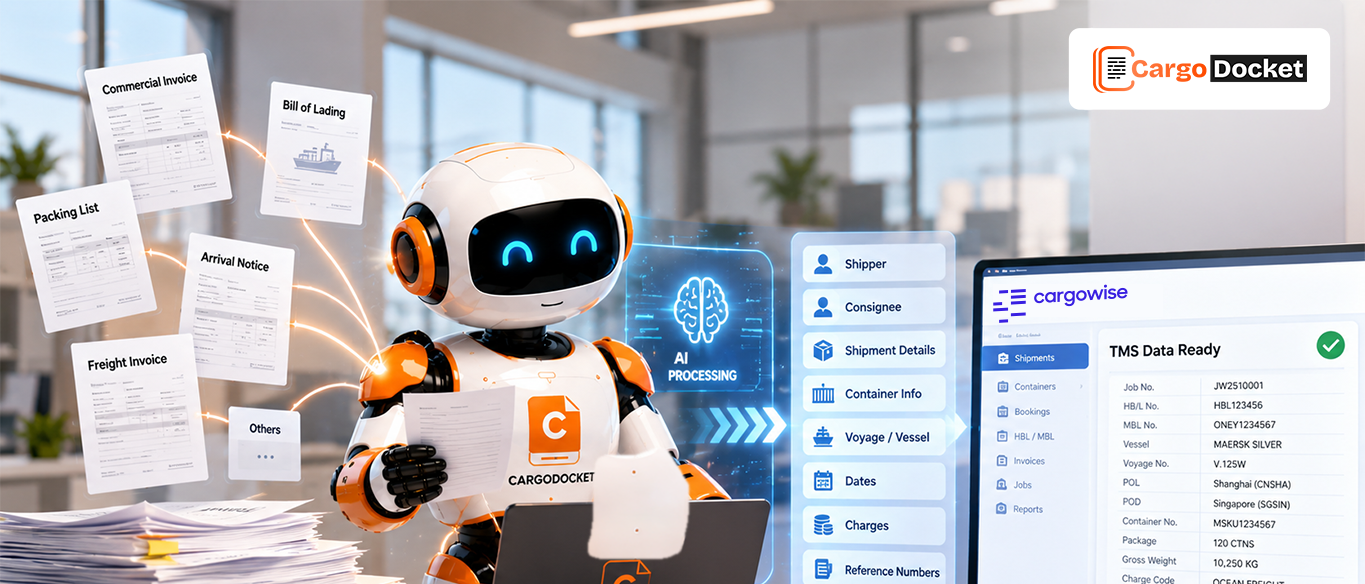
AI-powered document processing uses technologies such as Optical Character Recognition (OCR), Natural Language Processing (NLP), and machine learning to read shipment documents automatically.
Instead of simply extracting text, AI understands the information within each document, validates important shipment details, and organizes the data into a structured format that supports customs and logistics operations.
This allows logistics teams to spend less time processing paperwork and more time managing shipments and resolving exceptions.
📑 How AI-Powered Document Processing Improves Customs Data Accuracy at Every Stage of the Workflow?
Rather than automating just one task, AI supports the entire customs documentation process. from receiving freight documents to transferring validated data into CargoWise.
📥 Receive Documents
AI automatically collects shipment documents from emails, PDFs, portals, and other digital sources, organizing them for processing without manual sorting.
📄 Read & Extract the Data
Using AI, the system extracts key information from commercial invoices, bills of lading, air waybills, packing lists, and other customs documents.
🔄 Data Mapping and Conversion
The extracted information is standardized and mapped into the correct format, ensuring data remains consistent regardless of the document layout.
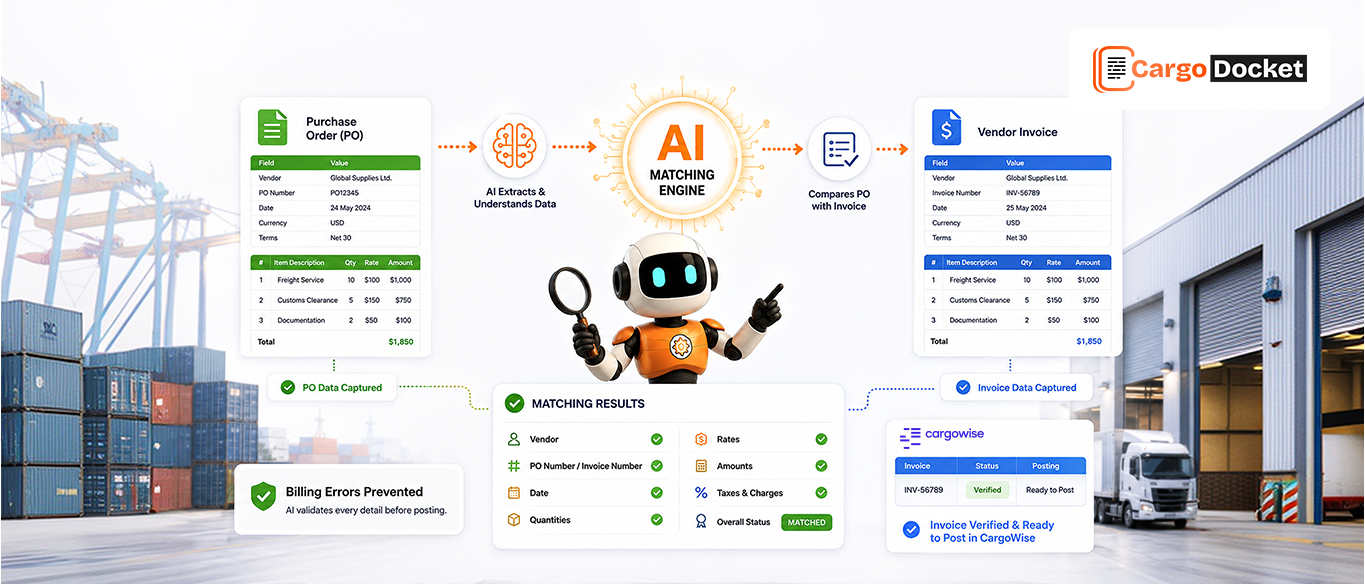
✔️ Compare the Shipment Data
AI compares information across multiple documents to identify missing details, mismatched values, incorrect HS codes, or other inconsistencies before customs submission.
⚙️ Workflow Management
Validated documents continue through the workflow automatically, while exceptions are routed to the appropriate team for review and approval.
🚀 Extract Data to CargoWise
Once validated, the shipment data is transferred directly into CargoWise, reducing duplicate data entry and improving the accuracy of customs and operational records.
🚢 How Better Document Accuracy Helps Logistics Teams Speed Up Customs Clearance and Reduce Delays?
Customs authorities rely on complete and accurate shipment information to process declarations efficiently.
When documents are validated before submission, customs brokers spend less time correcting errors, compliance teams handle fewer exceptions, and shipments move through customs with fewer interruptions.
For logistics businesses, this means:
- Faster customs clearance
- Fewer documentation errors
- Reduced compliance risks
- Less manual rework
- Better shipment visibility
- Improved customer satisfaction
Accurate documentation helps keep freight moving while giving teams more confidence in every shipment.
☁️ How AI Creates a Connected Customs Documentation Workflow Across Your Logistics Operations?
Customs documentation involves multiple teams, including operations, customs brokers, warehouses, finance, and customer service. Everyone depends on the same shipment information to keep freight moving.
AI-powered document processing creates a connected workflow by extracting, validating, and organizing data from every logistics document in one place. Instead of searching through emails or multiple systems, teams work with the same accurate and up-to-date shipment information.
This helps businesses:
- Improve collaboration across departments
- Reduce duplicate data entry
- Keep shipment information consistent
- Resolve document exceptions faster
- Increase visibility throughout the customs process
With everyone working from the same validated data, customs documentation becomes more efficient and easier to manage.
📈 Why AI-Powered Document Processing is Becoming the Future of Customs and Trade Compliance?
Logistics is also quickly embracing digital trade, electronic documentation, and automated compliance processes. As shipment volumes continue to grow, manual document handling is becoming increasingly difficult to scale.
AI-powered document processing helps businesses adapt by automating repetitive tasks, improving data quality, and supporting more consistent customs workflows. Rather than replacing logistics professionals, AI allows them to focus on higher-value activities such as compliance reviews, exception management, and customer service.
Businesses that modernize their document processing today will be better prepared for the future of international trade.
📌 Conclusion
Accurate customs documentation is essential for keeping international shipments moving without unnecessary delays. As shipment volumes grow, manual document processing becomes harder to manage.
AI Document Automation helps logistics teams automatically extract, validate, and transfer data from freight and customs documents, improving accuracy, reducing manual effort, and supporting faster customs clearance. Investing in smarter document automation today can help build a more efficient, compliant, and future-ready logistics operation.