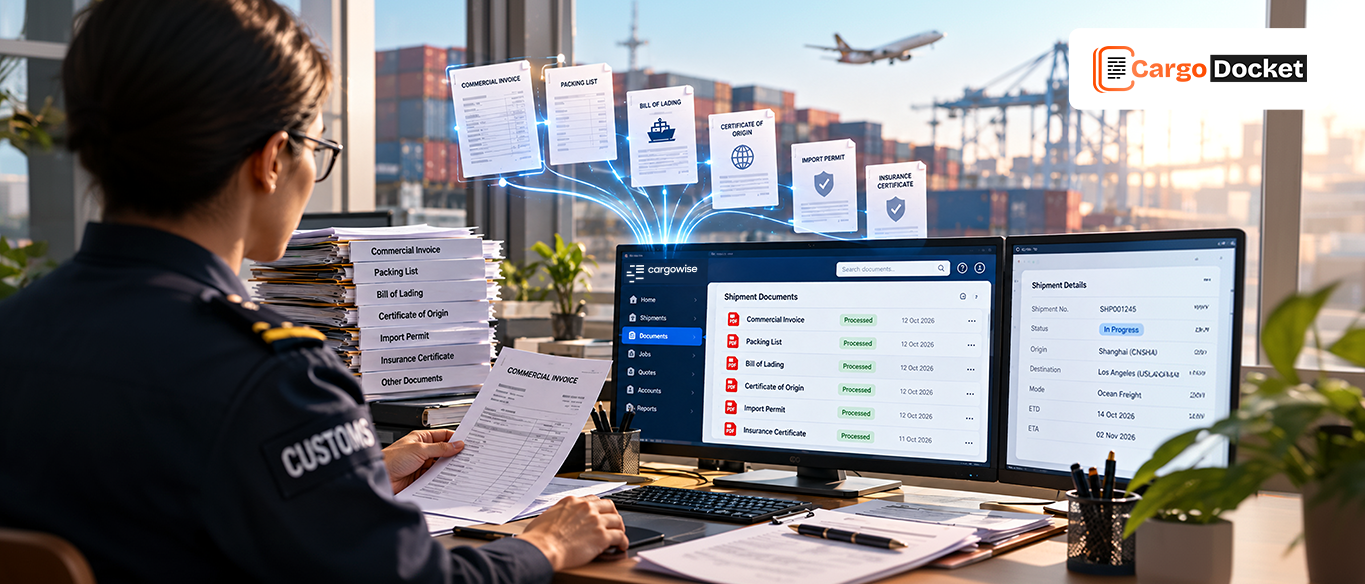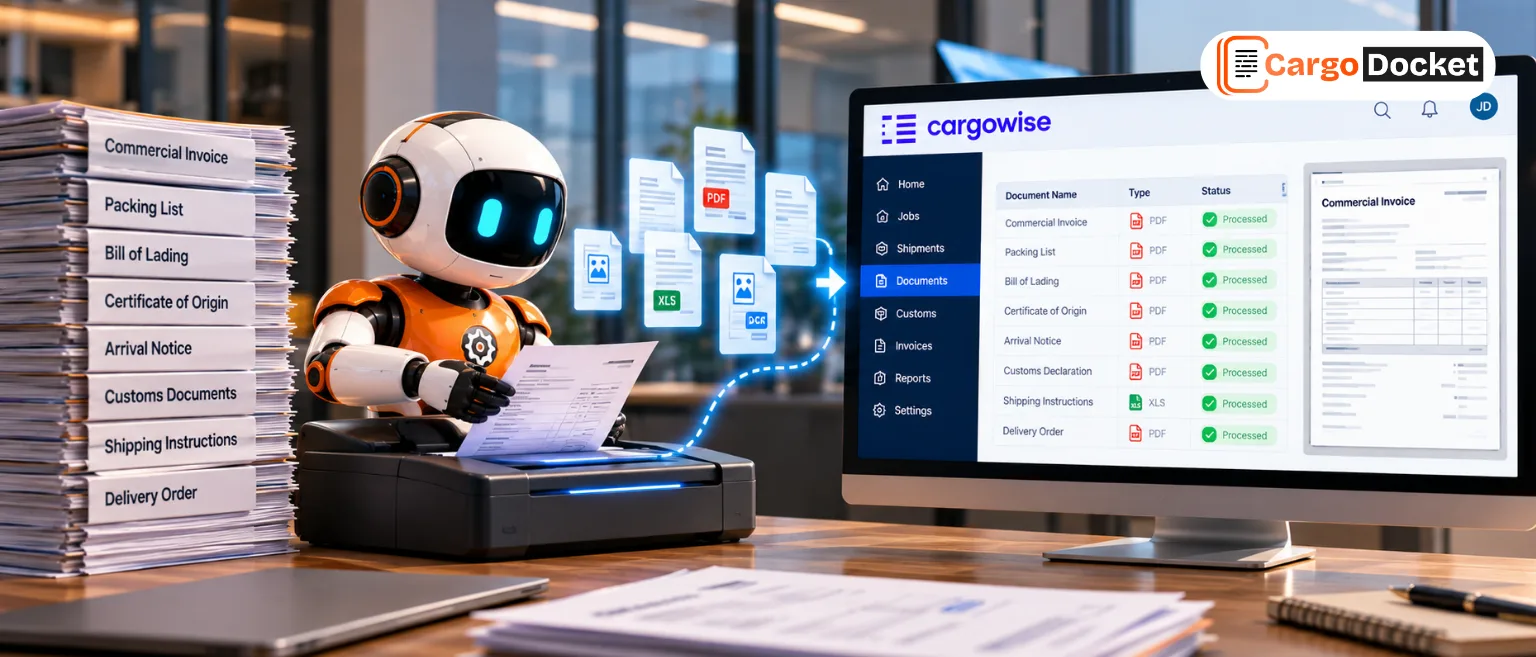

Bill of lading documents contain essential shipment details, but processing them manually can take time when every carrier uses a different layout. Some documents arrive as searchable PDFs, while others are scanned copies with inconsistent formatting. Your team still needs to identify the correct shipment information and enter it into CargoWise.
AI extracts bill of lading data by recognizing document labels, layouts, surrounding text, and the context of each field. It converts the information into structured data that can be validated before it is passed into the relevant CargoWise workflow.
What Makes Bill of Lading Formats Difficult to Process?
Bill of lading formats vary between carriers. The same shipment information may appear under different labels or in different sections of a document. A field that is easy to locate in one carrier’s document might appear somewhere else in another.
These differences create several challenges for teams handling multiple shipments every day:
- Different layouts: Shipper, consignee, vessel, and port details may appear in different positions across documents.
- Changing templates: Carrier document designs can change, making fixed extraction rules less reliable.
- Long container lists: Documents containing multiple containers, seal numbers, and cargo descriptions require careful data capture.
- Scanned documents: Low-quality scans, rotated pages, and unclear text can make manual reading and data extraction more difficult.
- Similar references: Bill of lading numbers, booking numbers, container numbers, and other references can be confused if they are not identified correctly.
When these details are entered manually, staff may need to switch between documents and CargoWise repeatedly. This increases processing time and creates opportunities for data entry errors.
How does AI Identify Shipment Details Across Different Carrier Formats?
AI document extraction goes beyond looking for information in fixed positions. It analyzes the document’s text, layout, labels, and relationships between fields to identify the information relevant to each data point.
For example, a carrier might label a location as “Port of Loading,” while another uses a different heading or places the port details in another section. AI can use the surrounding information and document structure to help identify the correct field, depending on the extraction solution and its configuration.
The process generally includes three stages.
1. Recognizing the document structure
Our AI converts text in scanned or image-based documents into machine-readable text. AI can then use that text alongside layout and contextual information to identify the relevant fields.
2. Extracting shipment information
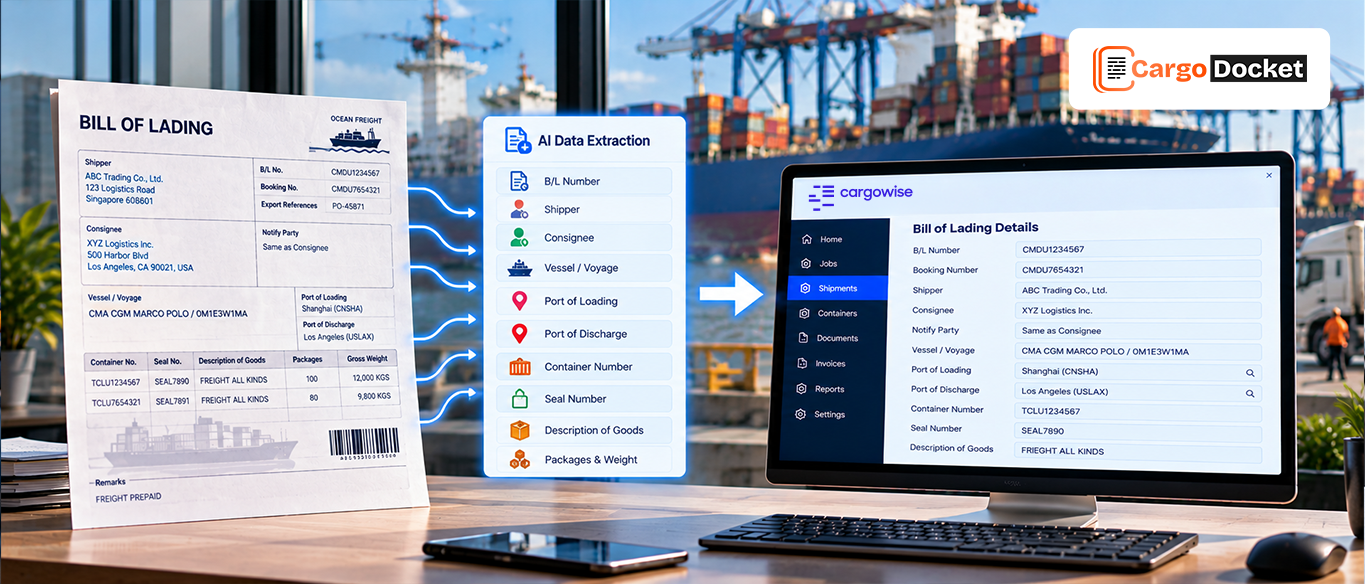
The system identifies key details commonly found in a bill of lading, such as:
- Bill of lading and booking numbers
- Shipper, consignee, and notify party details
- Vessel and voyage information
- Ports of loading and discharge
- Container and seal numbers
- Cargo descriptions, package counts, and gross weight
- Shipment dates and freight terms
3. Organizing the extracted data
The identified information is converted into structured fields so it can be checked, mapped, and prepared for the appropriate workflow. This reduces the need for employees to retype every field, although the extraction results still need suitable validation.
Which Bill of Lading Details Need Extra Checks?
Extracting information is only part of the process. The data must also be accurate enough to support shipment operations.
Some fields need additional attention because similar values can appear in the same document or because a small discrepancy can affect downstream processing.
For example, a bill of lading number should not be mistaken for a booking reference. Container numbers and seal numbers must remain associated with the correct containers, particularly when a document lists several containers.
Useful validation checks may include:
- Shipment references: Confirm that the bill of lading and booking numbers are mapped to the correct fields.
- Container details: Check container and seal numbers against the available shipment information.
- Cargo information: Review package counts, gross weight, and cargo descriptions for missing or conflicting values.
- Port details: Verify the ports of loading and discharge against the relevant shipment records.
- Party information: Check shipper and consignee details for inconsistencies.
- Dates and freight terms: Identify missing values or differences that may require clarification.
When information is missing, unclear, or inconsistent, the workflow should flag it for review rather than automatically treating it as correct. This allows staff to focus on exceptions instead of checking every field from scratch.
How does Extracted B/L Data Reach CargoWise?
Once the required information has been extracted, it needs to be mapped to the right fields and checked before being used in CargoWise. The exact workflow depends on the document type, available shipment data, and configured integration.
A typical workflow follows these steps:
- Receive the document: Collect the bill of lading from the configured source, such as an email or document repository.
- Identify and extract data: Our AI extraction capture relevant shipment details across supported carrier formats.
- Validate the information: Check extracted fields against available CargoWise records and defined business rules, where configured.
- AI Review exceptions: Send unclear, missing, or conflicting information to the appropriate team member for verification.
- Map data to post on CargoWise: Prepare approved information for the relevant CargoWise fields or workflow through the configured integration.
This approach helps reduce repeated data entry while keeping the necessary checks in place. It also gives operations teams a clearer process for handling documents that need manual attention.
What should You Check Before Choosing B/L Automation?
Not every document extraction solution handles carrier variations in the same way. Before introducing automation, assess how well the solution works with the documents your team receives and the checks your workflow requires.
Consider these points during evaluation:
- Different carrier formats: Test documents from several carriers, including different layouts and scanned copies.
- Field-level accuracy: Check whether the system correctly identifies shipment references, container details, parties, and cargo information.
- Exception handling: Confirm that missing or uncertain values can be flagged for human review.
- Validation rules: Understand whether extracted information can be checked against available shipment data and your team’s business rules.
- CargoWise mapping: Verify how approved data moves into the relevant CargoWise workflow and which steps still require manual input.
- Review and correction: Check whether staff can correct extraction errors and whether those corrections can support ongoing process improvements.
Testing with real documents is important. A solution may perform well on clean, consistent PDFs but need additional configuration to handle low-quality scans or unusual carrier layouts.
How can CargoDocket Help With Bill of Lading Automation in CargoWise?
CargoWise AI Document Automation is made to support document processing workflows connected to CargoWise. Depending on the configured workflow, it can help extract relevant information from supported bill of lading formats, organize the data into structured fields, and apply defined validation checks.
Where the workflow supports it, extracted information can be checked against available CargoWise data before being prepared for the relevant shipment process. Documents with missing details or discrepancies can be directed for review rather than passed through without the necessary checks.
For freight forwarding teams, the practical goal is to reduce repetitive document handling, limit manual retyping, and help staff identify issues earlier. The level of automation depends on the document formats, validation rules, and CargoWise workflow configured for your operation.
Make Bill of Lading Processing Easier for Your Team
Different carrier formats do not have to mean starting the data entry process from scratch every time. AI can help identify shipment details across varying layouts, while validation rules and exception handling help teams check the information before it moves into CargoWise.
The key is to combine reliable extraction with a workflow that accounts for missing data, conflicting references, and the checks your operation needs.
Want to understand how CargoWise AI Document Automation could fit your bill of lading workflow? Contact us to discuss your carrier formats, document validation requirements, and CargoWise integration needs