
Import operations move fast, but document processing often doesn’t. According to logistics industry reports, document-related inefficiencies can consume nearly 30–40% of operational processing time, especially when teams manually validate Bills of Lading before posting them into CargoWise.
Even a small mismatch between a Master Bill (MBL) and a House Bill (HBL) can create shipment delays, incorrect job postings, customs issues, and operational rework. As shipment volumes grow, manually organizing and validating import documents becomes harder to control.
That’s why logistics providers are adopting CargoWise Imports Bill of Lading Automation powered by AI document automation and advanced document grouping to validate Import Bills of Lading faster, reduce errors, and improve CargoWise workflow accuracy.
What is an Import Bill of Lading and Why is it Important?
An Import Bill of Lading (BoL) is one of the most important documents in international freight and import operations. It acts as a shipment contract, cargo receipt, and transportation document while connecting shipment information across logistics systems.
In import workflows, Bills of Lading contain critical details such as shipment references, consignee information, cargo descriptions, container numbers, ports, and vessel data. This information directly impacts shipment visibility, customs processing, CargoWise job creation, and operational planning.
There are typically two important document types involved:
- Master Bill of Lading (MBL) used by the carrier
- House Bill of Lading (HBL) is used by freight forwarders or consolidators
Both documents must align correctly before shipment data is processed inside CargoWise. If references or shipment details do not match, operational delays and posting issues become unavoidable.
What is Import Bill of Lading Automation and How does it Work?
Import Bill of Lading automation uses AI document automation to capture, extract, validate, and organize shipment data before it is posted into CargoWise.
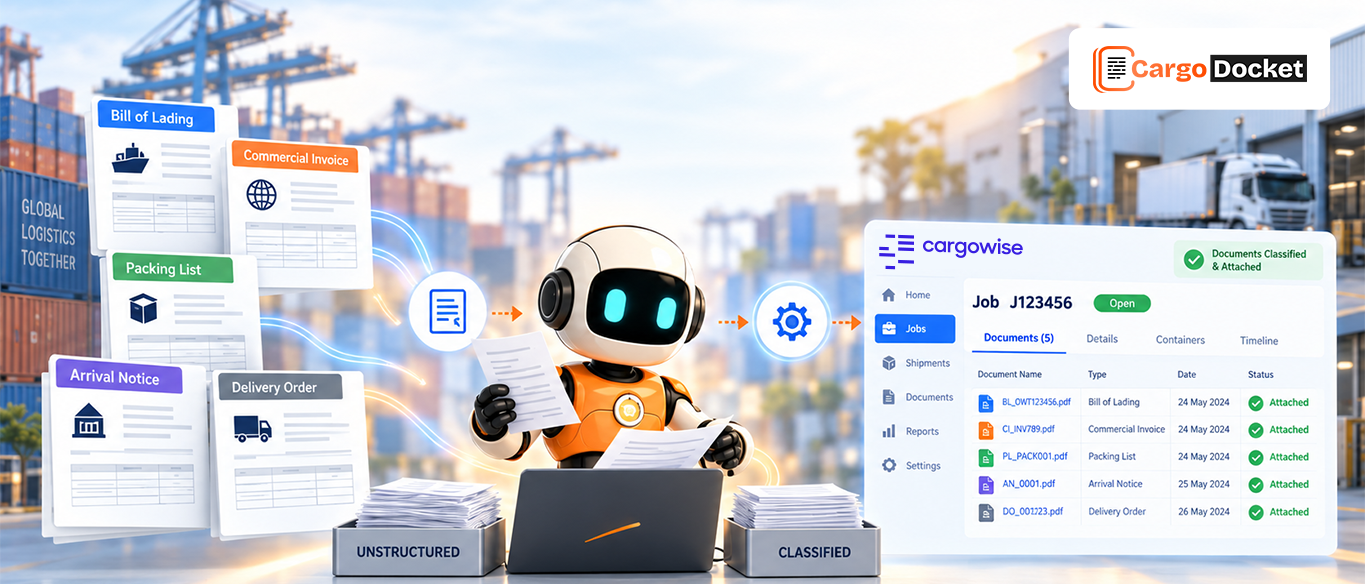
Instead of manually reviewing every MBL and HBL document, the system automatically reads shipment files, identifies key references, validates shipment information, and groups related documents together. This creates a faster and more controlled workflow where logistics teams spend less time handling repetitive document tasks and more time managing freight execution.
Import BoL automation typically helps with:
- Automatic extraction of MBL and HBL data
- Intelligent grouping of shipment-related documents
- Validation of consignee and container references
- AI exception handling for incomplete or incorrect documents
- Direct synchronization with CargoWise jobs
The goal is not just automation, but ensuring shipment data is validated and structured correctly before operational processing begins.
View our live Cargo Docket automation demo to see how Import Bills of Lading are automatically grouped, validated, and posted into CargoWise workflows in real time.
What Challenges do Logistics Teams Face with Manual Import BoL Processing?
Manual Bill of Lading processing creates operational pressure across freight forwarding and import teams, especially in high-volume logistics environments.
Documents arrive through multiple channels, such as emails, PDFs, scans, spreadsheets, and shipping portals. Teams must manually review and match these files before posting them into CargoWise.
This process becomes even more difficult when one Master Bill contains multiple House Bills linked to different shipments or consignees.
Common operational challenges include:
- Missing or incomplete HBL documents
- Incorrect MBL and HBL matching
- Duplicate shipment references
- Manual validation delays
- Incorrect posting into CargoWise jobs
The biggest issue is that teams spend valuable operational time organizing paperwork instead of focusing on shipment execution and customer service.
As shipment complexity grows, these workflows become harder to scale efficiently.
What is Advanced Document Grouping in Import BoL Automation?
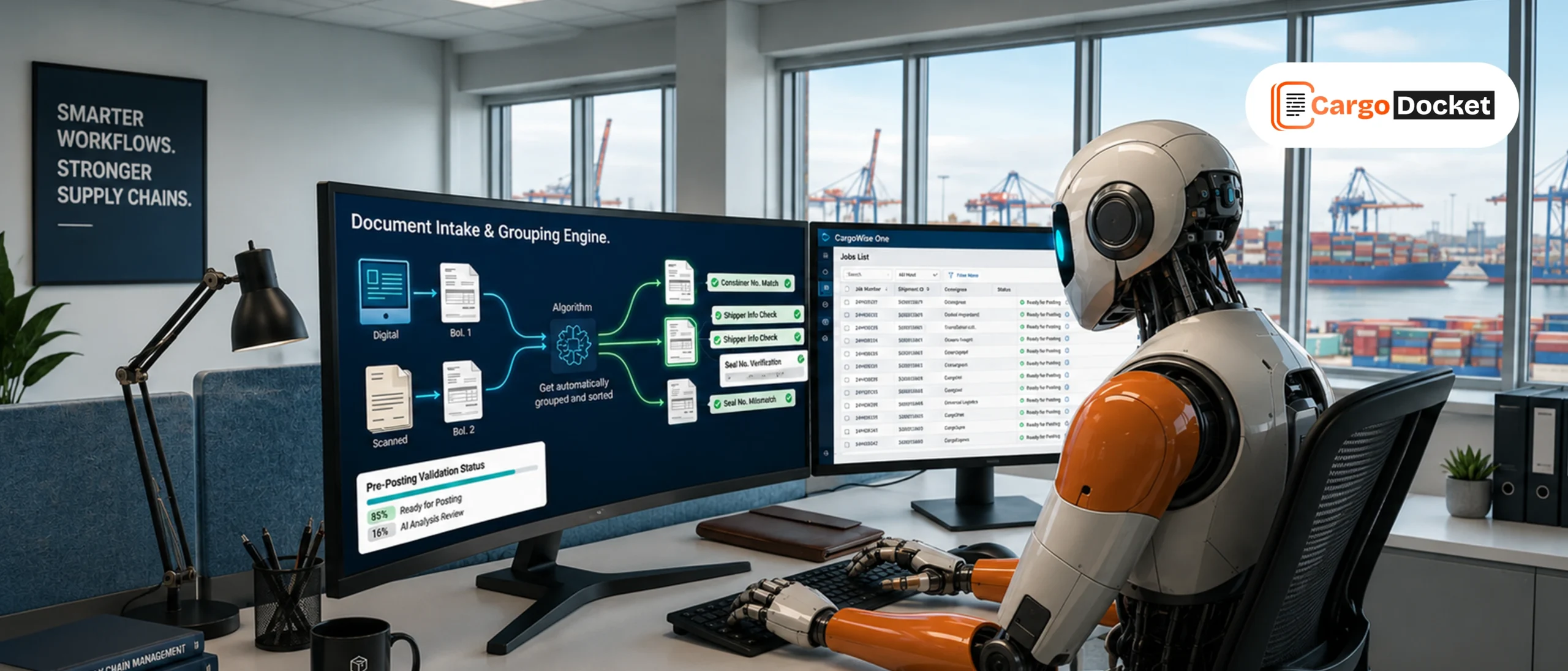
Advanced document grouping is an AI-driven process that intelligently organizes and validates shipment documents before they are posted into CargoWise.
Instead of manually sorting and linking multiple Bills of Lading, the system automatically identifies relationships between documents and groups them correctly using shipment references, consignee information, container data, and MBL/HBL associations.
This significantly improves workflow accuracy while reducing the risk of shipment mismatches.
Advanced grouping allows logistics teams to process large import files faster while maintaining control over document accuracy.
Advanced document grouping helps organize:
- Master Bills linked to multiple House Bills
- Multi-page import shipment files
- Container and consignee references
- Supporting shipment attachments and documents
- Multi-format shipment records from different sources
The result is a structured and validated import workflow before data reaches CargoWise.
How does Cargo Docket Validate Import Bills of Lading Before Posting to CargoWise?
Cargo Docket AI uses intelligent AI document automation to capture, validate, group, and process Import Bills of Lading automatically.
The system reads incoming shipment documents from PDFs, emails, scanned files, Excel sheets, and shipping portals. AI then extracts critical shipment information and validates it before posting to the correct CargoWise job.
The workflow typically includes:
- Automatic document capture from multiple sources
- AI extraction of MBLs, HBLs, and shipment references
- Intelligent grouping of related shipment files
- Validation checks against shipment and container data
- Posting validated documents directly into CargoWise
If information is incomplete or inconsistent, the workflow does not stop entirely. Instead, the document is routed into the AI exception handling manager, where operations teams can quickly review and resolve issues before posting.
This ensures that only validated and correctly grouped shipment data enters CargoWise workflows.
What Benefits do Logistics Teams Gain from Import BoL Automation?
The biggest advantage of automation is not just faster processing, but also improved operational control and shipment accuracy.
When Bills of Lading are processed manually, teams spend significant time validating shipment references, matching documents, and correcting errors. Automation removes much of this repetitive effort.
Key benefits include:
- Accelerated processing times
Shipment data is extracted and validated much faster, reducing delays in CargoWise job creation - Enhanced data accuracy
MBLs, HBLs, consignee details, and container references are validated automatically before posting - Proactive exception management
Missing or inconsistent documents are flagged instantly for operational review - Improved resource allocation
Teams spend less time on repetitive document tasks and more time managing freight execution - Smooth CargoWise integration
Shipment data flows directly into CargoWise jobs without manual intervention - Scalable operations
Automation supports higher shipment volumes without increasing operational workload
For many freight forwarders, automation reduces document-handling effort by 70–80% while improving overall shipment visibility and operational efficiency.
What Types of Import Documents can Cargo Docket Process?
Modern import operations involve multiple file formats and document structures. Cargo Docket AI is designed to support these complex logistics environments without requiring manual formatting or preparation.
Supported document types include:
- Single- and multi-page Bills of Lading
- Standard PDF and scanned PDF files
- JPEG, PNG, and TIFF image formats
- Excel and CSV shipment files
- DOCX and TXT documents
- Email attachments and embedded shipment files
- Multi-language shipping documents
This flexibility allows logistics providers to automate workflows across different carriers, suppliers, and international shipping partners.
How does AI Exception Handling Improve Import Workflow Accuracy?
One of the biggest operational risks in import processing is incomplete or inconsistent documentation.
Without exception handling, incorrect shipment data often flows downstream into CargoWise, creating posting errors, shipment delays, and operational confusion.
AI exception handling changes this completely.
Instead of allowing problematic documents to continue through the workflow, the system automatically identifies issues such as:
- Missing Bills of Lading
- Incorrect shipment references
- Duplicate files
- Mismatched MBL and HBL data
- Incomplete consignee or container details
These exceptions are flagged immediately for review before posting.
This proactive validation process reduces downstream troubleshooting and improves workflow reliability significantly.
Why is Import BoL Automation Becoming Essential for Modern Logistics Operations?
Global import operations are becoming more complex every year. Freight forwarders and logistics providers are managing larger shipment volumes, tighter timelines, and increasing customer expectations around visibility and accuracy.
Manual document workflows simply cannot keep pace with this level of operational demand.
Without automation:
- Shipment delays grow as document volumes increase
- Teams spend more time on repetitive validation tasks
- Data inconsistencies create CargoWise processing issues
- Incorrect MBL and HBL references lead to manual rework
With automation:
- Import workflows become standardized
- CargoWise job creation becomes faster and more reliable
- Exception handling becomes proactive instead of reactive
- Operations become easier to scale across regions and branches
This is why advanced document grouping and AI document automation are becoming essential for modern import freight operations.
Conclusion:
Import Bills of Lading are critical to shipment execution, but manual processing introduces delays, inconsistencies, and operational risk across import workflows.
By combining advanced document grouping, AI document automation, and CargoWise integration, logistics providers can validate shipment data faster, improve workflow accuracy, and simplify CargoWise job processing at scale.If your team is still manually reviewing and grouping Import Bills of Lading, now is the time to explore how Cargo Docket AI can automate validation, reduce operational errors, and accelerate your CargoWise import workflows. Contact us today to learn more.