
Logistics are not one-size-fits-all for invoices. Freight rates are volatile. Services are added, prices change, and customer disputes happen. If they do, finance teams will issue credit notes or debit notes to keep accurate financial records. These documents are important, but as the volume of transactions increases, verifying invoices, checking shipment details, and updating records manually can quickly become a time-consuming task.
Automated credit note and debit note processing with CargoWise AI makes it simple to retrieve, validate, and process financial information. This allows finance teams to cut down on repetitive work, increase accuracy, and process financial adjustments more efficiently.
Why are Credit Notes and Debit Notes Important in Logistics Finance?
Financial adjustments are a normal part of logistics operations. Shipment costs may change after invoicing, additional services may be billed, or pricing disputes may require corrections. Rather than canceling and recreating invoices, businesses use credit notes and debit notes to accurately record these changes.
In simple terms:
- Credit notes reduce the amount billed to a customer.
- Debit notes apply additional charges after an invoice has been issued.
- Both documents create a clear audit trail while keeping financial records accurate.
Although creating these documents sounds straightforward, every adjustment needs to be verified before it’s processed. Finance teams must confirm invoice references, shipment information, customer details, and pricing to ensure the correction is accurate.
As shipment volumes increase, handling these adjustments manually becomes more difficult, making speed and accuracy equally important.
What Makes Manual Credit Note and Debit Note Processing So Challenging?
For many logistics businesses, processing credit notes and debit notes still involves multiple manual steps. Even a simple adjustment often requires finance teams to search through invoices, verify shipment information, and update financial records before the document can be approved.
A typical process may include:
- Finding the original invoice.
- Verifying shipment and customer details.
- Reviewing freight charges or pricing agreements.
- Updating the adjustment in CargoWise.
- Sending the document for approval.
While each task may only take a few minutes, repeating the same process across hundreds of adjustments every week can significantly increase administrative work.
Studies show that finance teams spend a large portion of their time on repetitive document processing and reconciliation activities. Besides slowing productivity, manual processing also increases the risk of incorrect adjustments, duplicate records, and delayed customer responses.
These growing challenges are encouraging logistics businesses to automate routine financial processes with AI.
How does AI Automate the Process of Credit Notes and Debit Notes in CargoWise?
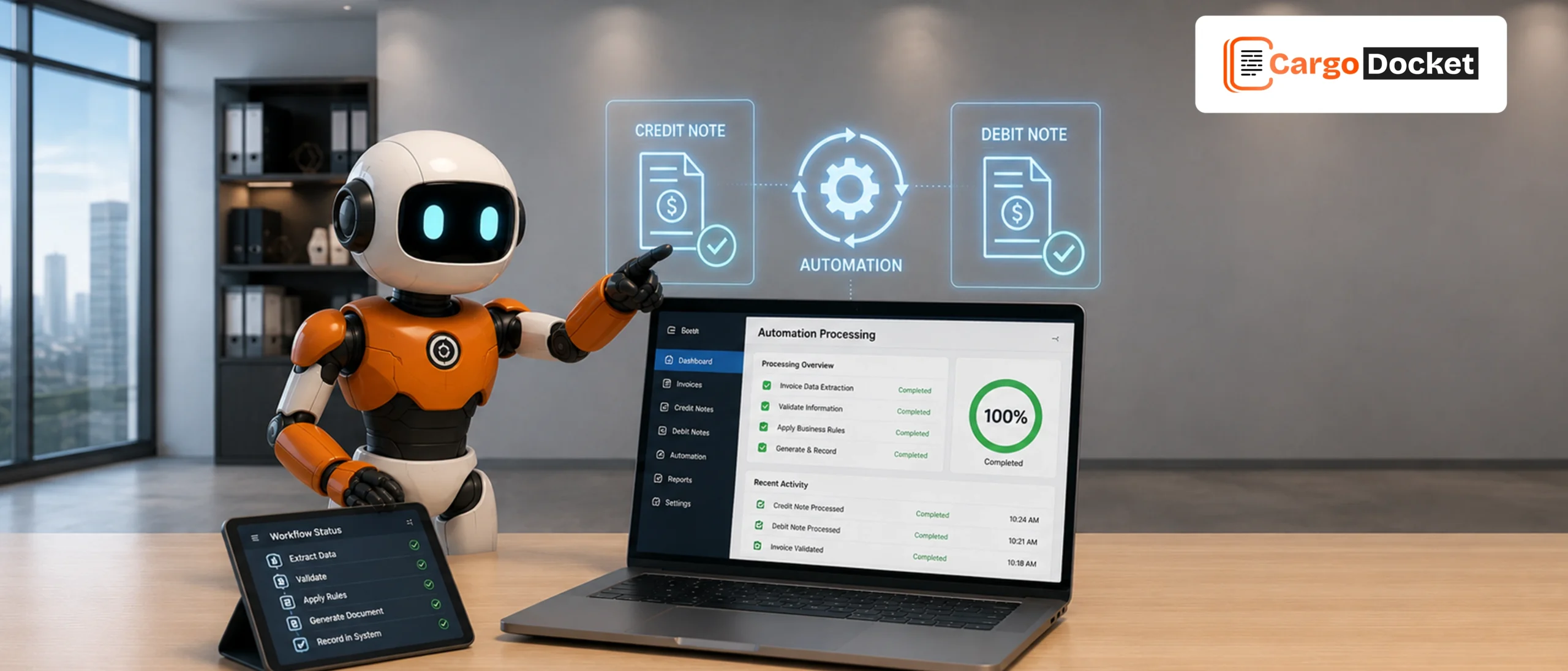
Instead of relying on manual document handling, AI follows a structured workflow to process financial adjustments more efficiently.
When a credit note or debit note request is received, AI automatically retrieves the related invoice and shipment information from CargoWise. It then validates the data before preparing the appropriate financial document.
The process typically includes:
- Retrieving the original invoice and shipment details.
- Comparing charge codes and pricing information.
- Validating customer and financial data.
- Preparing the correct credit note or debit note.
- Routing the document for approval.
- Updating CargoWise after approval.
Because routine validation happens automatically, finance teams spend less time processing standard adjustments and more time reviewing exceptions that require human judgment.
How does AI Improve Financial Accuracy Before Updating CargoWise?
Speed is valuable, but accuracy is what keeps financial records reliable. Before any adjustment is posted, AI verifies the information against predefined business rules to ensure the document is complete and consistent.
For example, AI can automatically check:
- Invoice reference numbers.
- Shipment records.
- Customer information.
- Charge codes.
- Tax calculations.
- Duplicate adjustment requests.
- Missing mandatory fields.
If something doesn’t match, the document is flagged for review instead of being processed automatically. This allows finance teams to focus on resolving exceptions while routine adjustments continue through the workflow.
By ensuring only validated information reaches CargoWise, AI helps reduce reconciliation issues, improve audit readiness, and maintain greater confidence in financial records.
What Changes When Credit Note and Debit Note Processing Becomes Automated?
Automating credit note and debit note processing improves more than just speed. It creates a smoother financial workflow by reducing repetitive tasks and ensuring billing adjustments are processed consistently.
Instead of spending time searching for invoices and verifying the same information repeatedly, finance teams receive validated documents that are ready for approval. This allows them to focus on exceptions and customer issues rather than routine administrative work.
As a result, businesses can benefit from:
- Faster processing of billing adjustments.
- Fewer manual data entry errors.
- Improved visibility into financial transactions.
- More accurate reconciliation and reporting.
- Faster response times for customer queries and disputes.
With every approved adjustment automatically reflected in CargoWise, finance and operations teams always work with the latest financial information.
Why is AI Becoming an Essential Part of Modern Logistics Finance?
As logistics businesses handle more shipments, financial operations become increasingly complex. Every invoice correction, pricing update, or customer dispute adds to the workload, making manual processing harder to manage.
AI helps finance teams keep pace by automating repetitive validation and document processing tasks. Rather than replacing human expertise, it supports finance professionals by reducing routine work and allowing them to focus on higher-value activities like financial planning, exception handling, and customer service.
This shift enables businesses to process more financial documents without increasing administrative effort, making finance operations more scalable as the business grows.
In today’s logistics industry, AI is becoming an important tool for improving financial accuracy, operational efficiency, and overall business performance.
Conclusion
Credit notes and debit notes are essential for maintaining accurate financial records, but processing them manually can be time-consuming and prone to errors. AI automation simplifies credit note and debit note processing in CargoWise by validating data, reducing repetitive work, and helping finance teams process billing adjustments more efficiently.
Ready to see AI automation in action? Schedule a demo and discover how you can simplify credit note and debit note processing in CargoWise, improve financial accuracy, and reduce manual effort.