
Finance automation can make a process faster, but faster is not always better if the financial setup underneath it isn’t right.
A supplier invoice can be captured automatically. A customer invoice can move through billing with fewer manual steps. Charges can flow from an operational job into financial processes. But if the General Ledger (GL), Chart of Accounts (COA), or charge codes are not configured consistently, automation can simply move the wrong information through the system faster.
That’s why finance automation in CargoWise starts with understanding the financial foundation first. CargoWise connects operational activity with accounting, including job costing, invoicing, payables, receivables, and general ledger reporting.
What do GL, COA, and Charge Codes Actually Mean?
These three terms can sound like accounting jargon, but each has a practical role.
The Chart of Accounts (COA) provides the structure used to organize financial activity. It helps a business categorize what it earns, spends, owns, and owes.
The General Ledger (GL) records the resulting accounting activity under the appropriate accounts and supports financial reporting.
Charge codes sit much closer to the operational side. They help represent the services, costs, and revenue associated with jobs and influence how those charges move into costing, billing, and accounting processes. CargoWise itself describes charge-code configuration as affecting how costs post, rate, and bill.
Put simply:
COA = Financial Structure
GL = Accounting Records
Charge Codes = Operational Charges Connected to Financial Treatment
Why does the Financial Setup Matter Before Automation?
Here’s the catch: automation follows the rules and information it is given.
Imagine a freight forwarding business that has several charge codes for similar services because different branches created their own versions over time. Finance may also have multiple accounts that essentially serve the same purpose.
Now automate the process.
The system may process transactions faster, but the underlying inconsistency is still there.
The source material highlights this exact concern: finance automation should be built on a reliable accounting structure rather than simply automating invoices or other visible tasks.
That makes configuration an important starting point, not something to clean up later.
How does the COA Shape Financial Reporting?
The Chart of Accounts is more than a list of account names. It provides the structure finance uses to understand business activity.
For example, a logistics company may want to distinguish different revenue and expense categories so management can understand how different services contribute to the business.
The challenge comes when an old COA is simply carried into a new system without reviewing whether it still makes sense.
You might find:
- Duplicate or similar accounts
- Outdated accounts
- Inconsistent naming
- Branch-specific structures
- Accounts that no longer support useful reporting
A cleaner approach is to ask what the business actually needs to report and how operational transactions should ultimately appear financially.
CargoWise supports general ledger reporting from the chart of accounts, including financial statements and live financial data.
Where do Charge Codes Fit Into the Picture?
Charge codes are where things can get particularly interesting for freight forwarders.
A charge may represent freight, handling, documentation, customs clearance, transportation, or another service. That charge begins with an operational activity, but it can eventually affect costing, billing, and accounting.
If similar services are represented by different charge codes, or users aren’t sure which code to select, the problem can spread downstream.
And here’s an important point: the goal isn’t necessarily to have fewer charge codes. The goal is to have the right codes used consistently for the right transactions.
That consistency gives automation a much clearer foundation to work with.
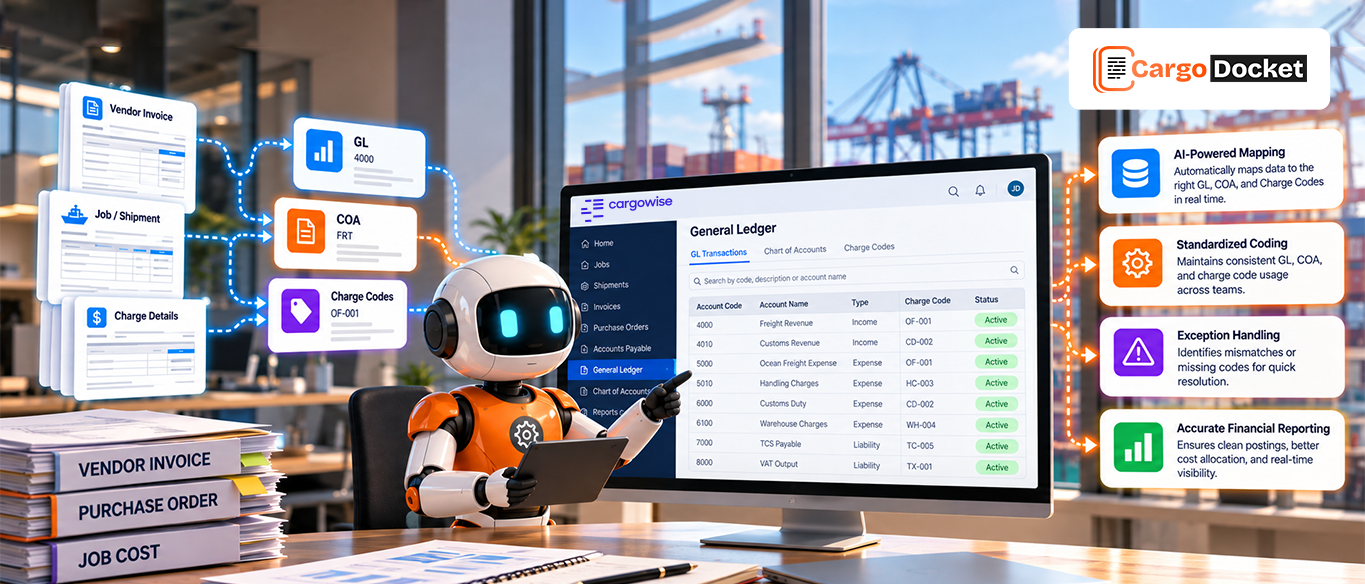
How are GL, COA, and Charge Codes Connected?
These three areas shouldn’t be treated as separate pieces of the finance setup.
The COA establishes the financial structure.
The GL records the accounting activity.
The charge codes help connect operational activity and charges with the financial process.
So a decision made around a charge code can ultimately affect what finance sees in its accounting and reporting.
For example, if two branches use different codes for the same service, the operational work may be completed without an issue. But later, finance may have to spend time reconciling or restructuring the information for reporting.
That’s why finance and operations need to look at the setup together.
Where can CargoDocket’s AI Automation Help?
Once the underlying structure is reliable, AI document automation can help reduce repetitive financial data work.
For example, when a financial document arrives, AI can read the document, identify relevant information, and structure the data according to configured rules before it moves into the next stage.
A practical workflow could look like:
Financial Document Received → AI Reads Data → Relevant Information Identified → Data Mapped to Configured Fields → Validation → Exceptions Flagged → CargoWise Processing
This doesn’t mean AI should independently decide your accounting policies. Instead, it can handle repetitive information processing based on the rules your business has already established.
That distinction matters.
Good automation follows a trusted financial process; it doesn’t replace the need for one.
What should You Review Before Expanding Finance Automation?
Before automating more financial activity, take a look at where your team is still making repetitive corrections.
Are accountants regularly changing transaction treatment after posting? Are similar services using different charge codes? Do branches follow different practices? Does finance frequently need to ask operations what a charge means? Are invoice corrections common?
Those are useful warning signs.
They may indicate that the next step isn’t simply adding another automation. It may be better to review the underlying configuration first.
The source material recommends reviewing areas such as the COA, GL configuration, charge-code structure, organization accounting settings, currencies, tax requirements, security, and AP/AR processes according to the company’s CargoWise scope.
How can AI Automation Make Finance Work Easier?
Once the financial foundation is clear, automation can take on more repetitive work without making the process harder to control.
Instead of finance teams checking every routine transaction, AI can help process does information, apply configured rules, and bring unusual cases to their attention.
That shifts the focus from checking everything to reviewing what actually needs attention.
CargoWise already provides integrated accounting across areas such as AP, AR, job costing, and the general ledger, so automation can be considered around the financial processes already connected to operational activity.
How can CargoDocket Support AI Automation in CargoWise?
CargoDocket can support the financial document workflow by using AI to read incoming documents and capture the information your configured process requires.
Once the information is extracted, it can be structured and checked against the relevant rules. If something is missing, unclear, or doesn’t meet the expected requirements, it can be separated for review rather than moving forward unchecked.
The process can follow:
Document Received → AI Reads → Data Extracted → Information Validated → Exceptions Reviewed → Data Prepared for CargoWise
This keeps the automation focused on repetitive document work while your finance team stays involved where review, approval, or financial judgment is needed.
Conclusion
GL, COA, and charge codes may sit behind the scenes, but they play an important role in how operational activity becomes financial information in CargoWise.
When those structures are clear and consistently used, automation has a stronger foundation. AI can then help reduce repetitive document and data-processing work, identify exceptions, and keep routine financial workflows moving.
Ready to make financial document processing easier in CargoWise? Contact us to see how AI document Automation can help capture, validate, and structure financial information while keeping your team focused on the transactions that need human attention.