
Your documentation team receives a Bill of Lading for a shipment of 500 cartons. The container number, vessel details, and consignee information all look correct. But there’s one small remark from the carrier: “Five cartons received damaged.”
That single remark can change the document from a clean bill of lading to a Claused bill of lading. If the shipment involves payment through a Letter of Credit (L/C), it could also lead to payment delays and additional document checks.
For freight forwarders handling multiple shipments, identifying these remarks while verifying shipment details isn’t always straightforward. Understanding the difference between clean and closed bills of lading helps your team recognize potential issues early, while AI document automation can simplify document verification before shipment data moves into CargoWise.
What is the Difference Between Clean and Claused Bills of Lading?
A Bill of Lading (B/L) is an important shipping document issued by a carrier or its authorized agent. It serves as a receipt for goods, provides evidence of the contract of carriage, and, depending on its type, may act as a document of title.
The main difference between a clean and claused B/L is whether the carrier has recorded an apparent defect in the goods or their packaging.
Clean Bill of Lading: A Clean B/L contains no remarks expressly declaring defective cargo or packaging. For example, if a carrier receives 500 cartons without noting any visible damage, it may issue a clean B/L.
Claused Bill of Lading: Also called a Dirty or Foul B/L, it contains remarks identifying apparent defects, such as damaged cartons, leaking drums, or broken packaging.
| Clean Bill of Lading | Claused Bill of Lading |
| No express remarks identifying defective goods or packaging | Contains remarks identifying apparent defects |
| Example: No cargo damage noted | Example: “Five cartons received wet” |
| Meets the clean-document requirement under UCP 600 | May create a discrepancy under a Letter of Credit |
| Does not guarantee the absence of hidden damage | Records an observed cargo-condition issue |
A clean B/L doesn’t need the word “Clean” printed on it. What matters is the absence of remarks expressly identifying defective goods or packaging.
What are the Common Causes of a Claused Bill of Lading?
A carrier may issue a Claused Bill of Lading when it observes defects in the cargo or packaging at the time of receipt.
For freight forwarders, understanding these causes helps identify potential problems before shipping documents are finalized.
Common causes include:
- Damaged cargo: Goods arrive with visible dents, cracks, or other physical damage.
- Wet or torn packaging: Cartons, bags, or crates show moisture damage or tears.
- Leaking drums: Liquid cargo containers show visible signs of leakage.
- Inadequate packaging: Packaging appears damaged or insufficient to protect the goods.
- Visible cargo shortages: The carrier records fewer packages than expected, requiring further investigation.
For example, suppose your customer ships 200 cartons of electronic equipment, but five cartons arrive at the terminal visibly wet. The carrier records this condition on the B/L, making it a claused document.
If your team overlooks the remark, the shipment details may still be entered correctly in CargoWise, but the cargo-condition issue could remain unresolved.
Which Bill of Lading Remarks and Discrepancies should Your Team Check?
Not every remark on a Bill of Lading makes it claused.
Carriers often include standard statements explaining that certain shipment information was provided by the shipper rather than independently verified.
| B/L remark | Example | Interpretation |
| Cargo damage | “Three cartons crushed” | Claused |
| Packaging defect | “Two wooden crates broken.” | Claused |
| Shipper’s Load and Count | “Contents loaded and counted by shipper” | Not automatically claused |
| Said to Contain | “Container said to contain 200 cartons” | Not automatically claused |
Under ICC UCP 600 Article 27, a clean transport document must not expressly declare defective goods or packaging. Standard carrier qualifications generally don’t affect its clean status.
Your team should also check container numbers, seal numbers, cargo quantities, and consignee details. Incorrect information may not make the B/L claused, but it can create documentation discrepancies when compared with shipping instructions or CargoWise shipment records.
How can Claused Bills of Lading Affect Shipments and L/C Payments?
When an international shipment is paid through a Letter of Credit, banks examine shipping documents against the credit’s requirements and applicable documentary credit rules.
Under UCP 600 Article 27, banks require clean transport documents. A B/L containing an express cargo-damage remark can therefore create a discrepancy.
For example, if an exporter presents a B/L stating “two wooden crates damaged,” the bank may refuse the presentation as discrepant. The parties may then need to resolve the issue or seek an appropriate waiver.
For freight forwarders, these issues can create several operational challenges:
- Payment delays: Claused documents may not satisfy L/C requirements.
- Documentation corrections: Incorrect shipment information may require amendments.
- Cargo claims: Recorded damage remarks can become important evidence.
- Customer disputes: Conflicting shipping documents can create confusion.
- Additional workload: Your team must coordinate with carriers, shippers, and customers.
Identifying these issues during draft B/L verification can help reduce unnecessary delays and documentation rework.
Why is Manual Bill of Lading Verification Challenging for CargoWise Users?
Bills of Lading arrive through emails, scanned PDFs, and different carrier templates. Your documentation team must review each document and compare it with shipping instructions and packing lists, and verify important information against CargoWise shipment records.
A cargo-damage remark may appear in small print, handwritten notes may be difficult to read, or a seal number might differ by just one digit.
When employees manually extract information and compare multiple documents, these discrepancies can easily be overlooked.
The challenge isn’t simply entering shipment data into CargoWise. It’s making sure important remarks and incorrect details are identified before the information moves further through your operations.
How can AI Automation Detect B/L Remarks and Discrepancies in CargoWise?
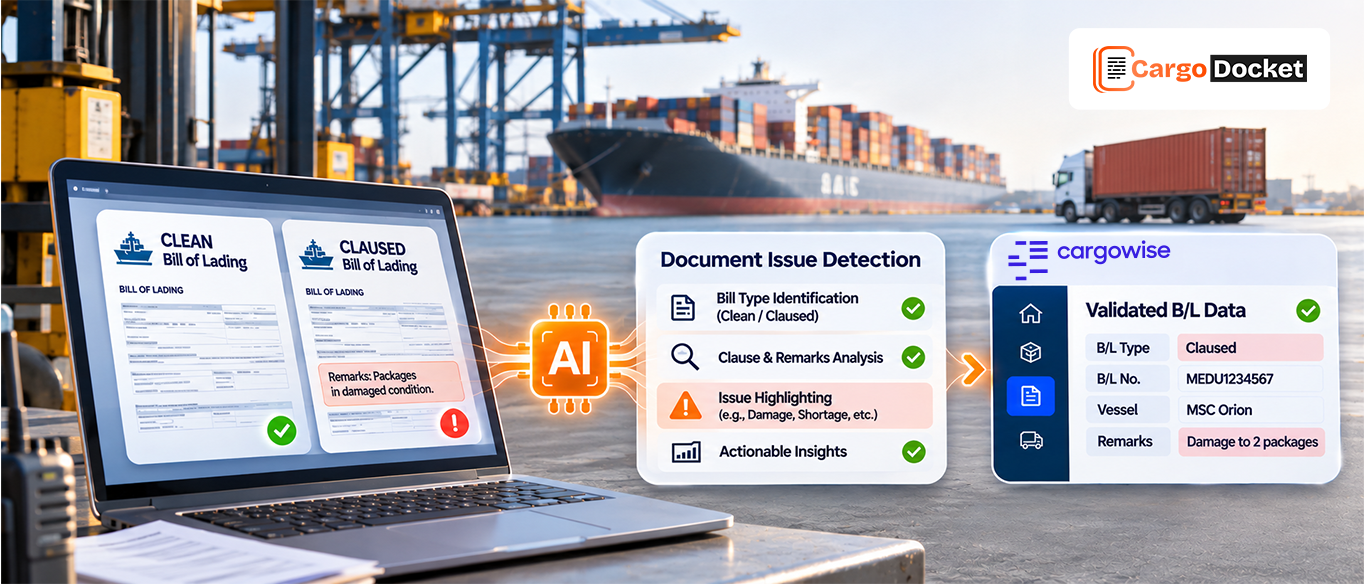
AI Document Automation helps simplify verification by extracting shipment information, analyzing B/L remarks, and comparing details against available records.
Instead of manually checking every field, your documentation team can focus on issues that actually need attention.
Here’s how a configured AI workflow works:
- Receive the B/L: AI processes incoming PDFs, scanned documents, or other supported formats.
- Extract information: It captures container numbers, seal numbers, quantities, cargo descriptions, and other shipment details.
- Identify remarks: AI analyzes wording to recognize potential cargo damage or defective packaging.
- Compare records: Extracted details are checked against shipping instructions, packing lists, or available CargoWise data.
- Flag discrepancies: Missing fields, mismatched information, and important remarks are highlighted for review.
For example, suppose a B/L contains the remark “five cartons wet,” while its seal number doesn’t match the shipping instructions.
A properly configured AI workflow can identify both issues separately, helping your team distinguish cargo-condition exceptions from ordinary data discrepancies.
Your documentation executive can review the original document, verify the details, and contact the carrier or shipper when necessary. Any genuine cargo damage must be investigated and documented accurately rather than simply removing the remark.
Once the issue is resolved and the information is approved, the verified data can continue through the configured CargoWise workflow.
How does CargoDocket AI Document Automation Help Verify Bills of Lading in CargoWise?
For freight forwarders using CargoWise, manually extracting B/L information and comparing multiple documents can consume valuable time. Every logistics business also has its own document formats, validation requirements, and approval processes.
With CargoWise Bills of Lading Automation, freight forwarders can simplify document extraction, verify shipment details, and identify potential discrepancies before information moves further into their CargoWise workflows.
Depending on your operational requirements, CargoDocket can help your team:
- Extract shipment information from different Bill of Lading formats.
- Compare document details against available CargoWise records.
- Identify missing fields and mismatched shipment information.
- Flag potentially problematic cargo-condition remarks through configured validation rules.
- Route document exceptions for review before further processing.
- Prepare verified shipment data for CargoWise workflows.
We customize CargoDocket to fit your existing CargoWise workflows, including your document formats, validation rules, approval processes, and exception-handling requirements.
This means your documentation team can spend less time repeatedly checking shipment details and more time resolving the exceptions that need attention.
Identify B/L Discrepancies Before they Affect Your Freight Operations
A missed cargo remark or incorrect shipment detail can lead to payment delays, documentation corrections, and unnecessary follow-ups.
With CargoDocket AI Document Automation, customized to your CargoWise workflows, your team can identify discrepancies earlier, reduce manual verification, and improve document processing.
Still spending hours manually checking Bills of Lading? Contact us to explore how we can customize your freight forwarding workflows and help your team manage document discrepancies more efficiently.