
Global shipment volumes continue growing, and document processing complexity is growing with them. Studies suggest that nearly 80% of logistics information still enters operational systems through documents, creating challenges for teams handling high shipment volumes.
Export Bill of Lading documents no longer arrive in one standard format. Teams receive scanned PDFs, image files, spreadsheets, multi-language files, and email attachments from multiple partners and carriers. As document volumes increase, manually reviewing and processing these files creates delays that eventually affect shipment execution.
This is why logistics businesses are increasingly adopting AI-powered document processing in CargoWise to simplify export workflows and improve operational efficiency.
What is CargoWise Export Bill of Lading and Why does it Matter?
An Export Bill of Lading is one of the most important documents within international freight operations. It acts as a shipment contract, receipt of goods, and proof of ownership while supporting the movement of cargo across the supply chain.
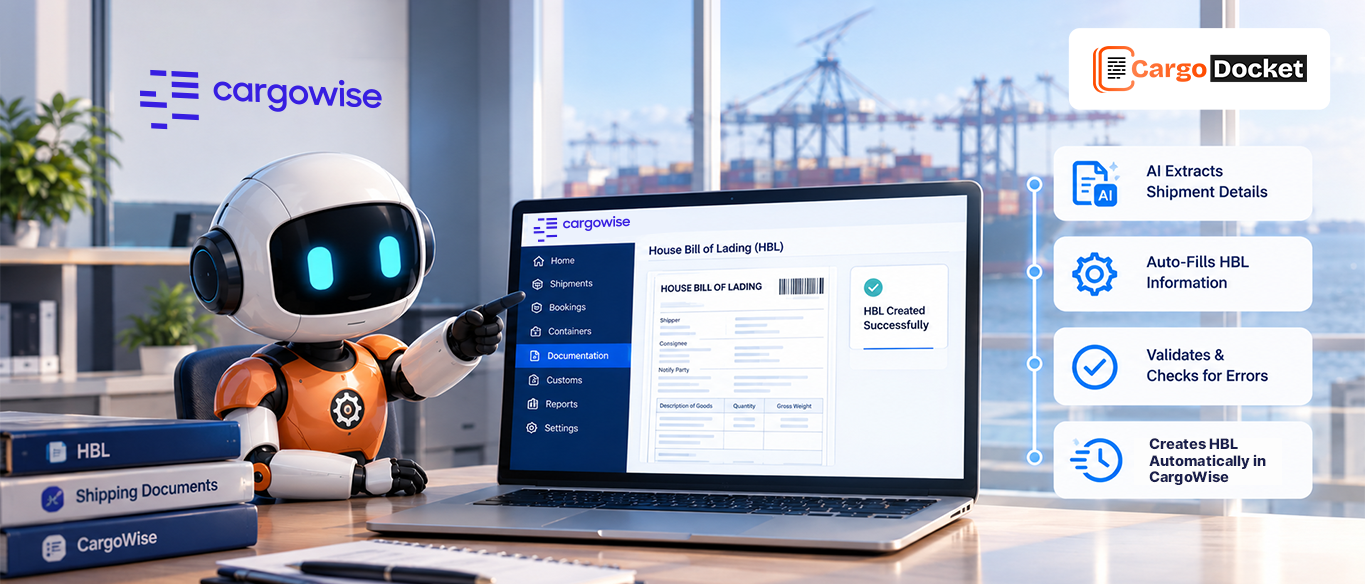
AI helps simplify CargoWise Exports Bill of Lading Automation by automatically extracting shipment information, validating document fields, and reducing manual document handling across export workflows
Typical shipment information includes:
- Shipper information
- Consignee details
- Cargo descriptions
- Container information
- Bill references
- Port details
- Freight terms
Accurate information is critical because even small document inconsistencies can create downstream operational issues.
These issues often include:
- Delays in shipment processing
- Incorrect job creation
- Additional manual corrections
- Customs processing issues
- Reduced shipment visibility
As shipment volumes continue growing, document accuracy becomes increasingly important.
Why Export Document Workflows are Becoming Harder to Manage?
Modern logistics operations rarely receive documents from one standardized source.
Export teams frequently work with information coming from customers, carriers, suppliers, and external partners, all using different templates and document structures.
This creates several operational challenges.
Teams commonly deal with:
- Multiple document sources
- Different customer templates
- Carrier-specific formats
- Supporting shipment files
- Multiple language requirements
- Invoice files in different currencies
The challenge is not receiving documents. The challenge is maintaining speed and consistency while processing them.
As shipment volumes increase, repetitive document handling activities create operational pressure and reduce productivity.
Where Multi-Format Documents Start Creating Processing Delays?
Export operations often become difficult not because documents are missing, but because shipment information arrives in multiple formats and structures.
Logistics teams regularly receive Export Bill of Lading documents through scanned PDFs, image files, spreadsheets, and email attachments from different customers, carriers, and partners. Since every source follows a different layout and format, teams frequently spend additional time reviewing files, extracting shipment information, validating references, and entering data into CargoWise manually.
The process often includes several repetitive activities:
- Opening documents individually
- Searching for shipment details
- Comparing references across files
- Re-entering information manually
- Verifying shipment data multiple times
While these tasks may only take a few minutes per shipment, processing hundreds or thousands of shipment files every month creates significant operational inefficiencies.
Small delays repeated across large shipment volumes eventually create larger workflow obstacles.
How does AI Process Multi-Format Export Bill of Lading Documents in CargoWise??
AI changes document processing by eliminating much of the repetitive work that logistics teams handle manually.
Instead of asking users to review every file individually, AI automatically reads documents and identifies important shipment information regardless of format or layout.
The process generally follows several stages.
Step 1: Document Intake
Shipment files are received through multiple channels:
- Email attachments
- Upload portals
- Shared folders
- External systems
Step 2: Intelligent Data Extraction
AI identifies key shipment information such as:
- Bill numbers
- Shipment references
- Consignee details
- Container numbers
- Cargo descriptions
- Port information
Step 3: Validation and Matching
The extracted information is then reviewed for:
- Missing fields
- Incorrect values
- Duplicate references
- Data inconsistencies
Step 4: Synchronization into CargoWise
Validated information automatically moves into CargoWise workflows for further operational processing.
This reduces manual effort while creating a faster and more structured process.
How Cargo Docket Supports Complex Export Document Workflows?
Managing multiple file formats manually often creates unnecessary complexity.
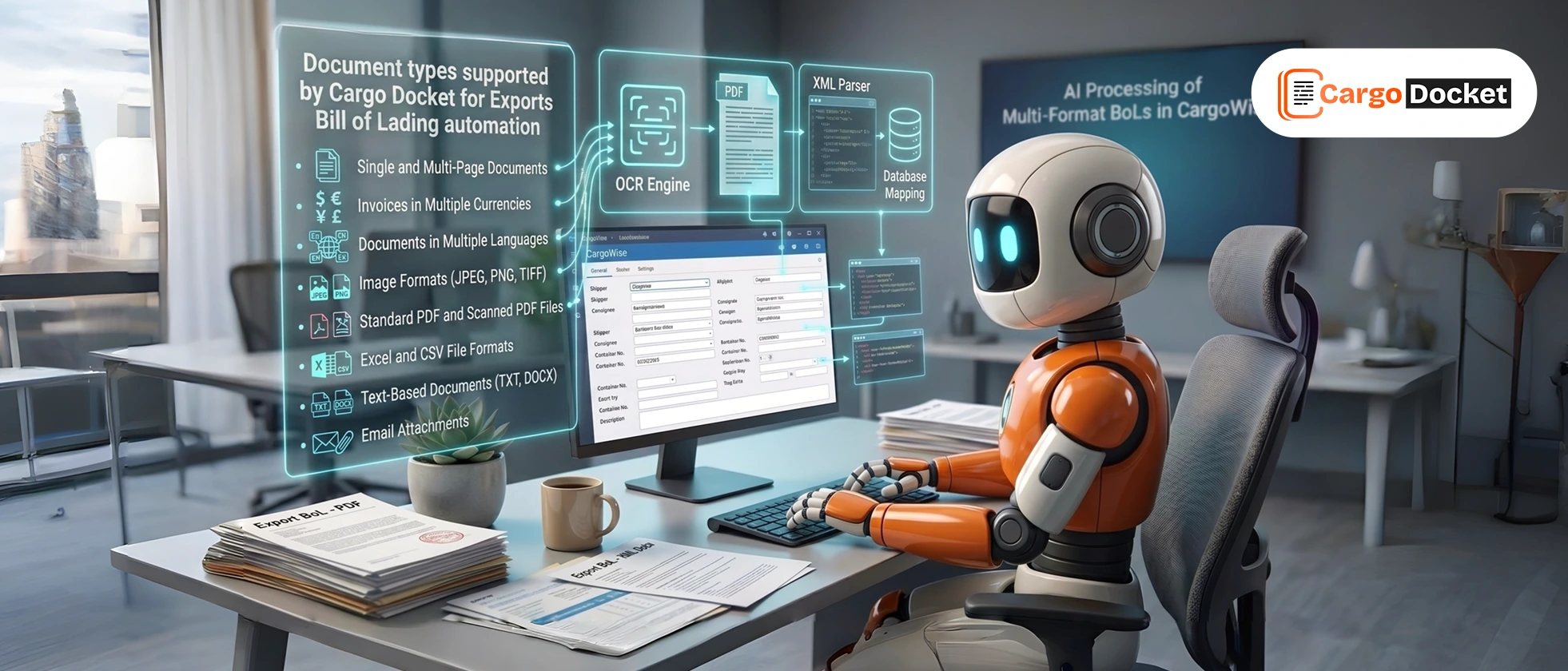
Cargo Docket simplifies this challenge by supporting various document formats without requiring operational teams to create separate workflows.
The platform supports:
- Single and multi-page documents
- Documents in multiple languages
- Invoice files in multiple currencies
- JPEG, PNG, and TIFF images
- Standard and scanned PDF documents
- Excel and CSV files
- TXT and DOCX files
- Email attachments
Instead of forcing teams to convert or reorganize files before processing, Cargo Docket automatically understands document structures and extracts relevant information.
This creates a connected workflow where teams spend less time preparing files and more time focusing on shipment execution.
How AI Creates Better Visibility Across Export Operations?
Document automation creates more than processing speed improvements, It creates operational visibility.
Without automation, shipment information often remains spread across emails, folders, spreadsheets, and disconnected systems. Teams frequently spend valuable time locating information rather than acting on it.
With AI-powered workflows, organizations often experience improvements such as:
- Faster shipment processing
- Reduced manual entry work
- Improved document visibility
- Fewer processing errors
- Better productivity
- Increased scalability
Industry studies indicate that document automation can reduce repetitive processing activities by 50–70% in high-volume environments.
As shipment activity grows, these operational gains become increasingly valuable.
How Modern Logistics Teams Move Beyond Manual Document Work?
One of the biggest advantages of automation is not simply processing documents faster.
The larger impact is allowing experienced logistics professionals to focus on work that creates business value.
Instead of spending hours reviewing files and correcting shipment information, teams can focus on:
- Shipment planning
- Customer communication
- Operational improvements
- Exception handling
- Strategic activities
This shift helps organizations improve operational performance while supporting long-term growth.
Conclusion
Export Bill of Lading processing is becoming more complex as shipment volumes and document sources continue increasing. Handling PDFs, images, spreadsheets, and email attachments manually creates unnecessary delays and operational inefficiencies.
With the help of AI capabilities, logistics teams can process shipment data faster and reduce repetitive manual tasks. Ready to simplify Export Bill of Lading workflows? Contact us today to see how Cargo Docket can automate multi-format document processing and help your team move freight faster.