

In freight forwarding, even one wrong field in a Purchase Order (PO) can trigger incorrect charges and delayed invoicing. Yet POs are still handled manually, forcing teams to search emails, recheck vendor details, and retype data into systems, slowing everything down.
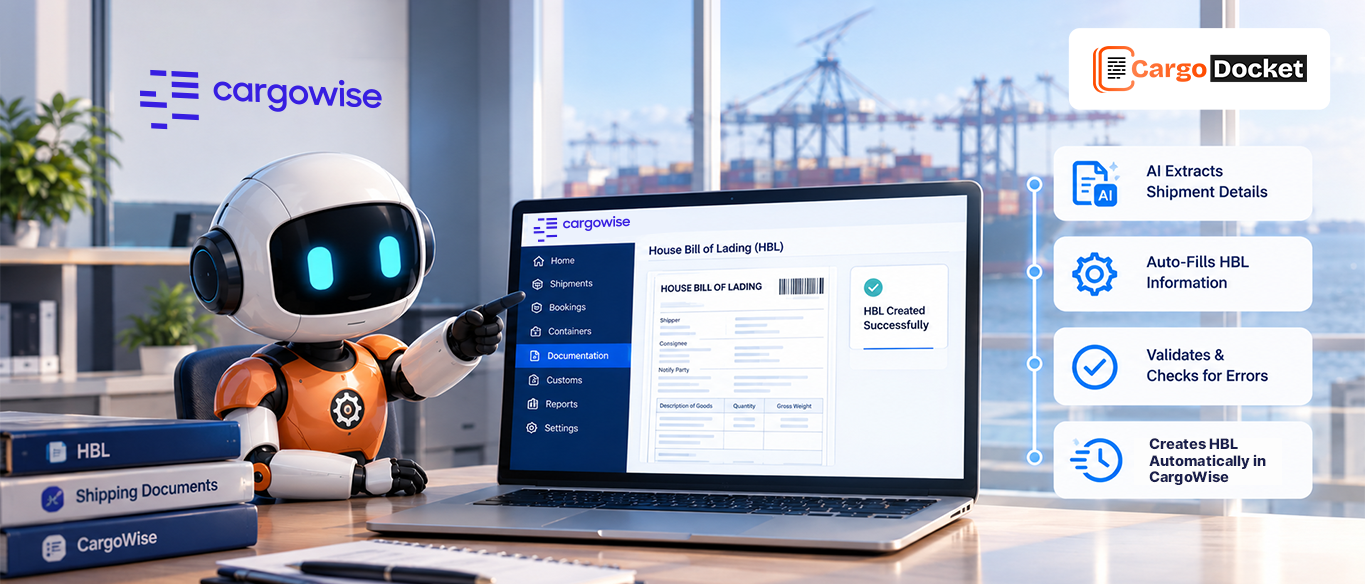
AI PO automation reads, validates, and pushes PO data directly into CargoWise, no manual entry needed with CargoDocket, teams cut paperwork, reduce errors, and ensure every PO enters the order → shipment → invoice flow is clean and accurate.
For forwarders, brokers, 3PLs, and logistics companies, understanding and automating POs is now essential for smoother operations and better profitability.
What is a Purchase Order?
A Purchase Order (PO) is a formal document a buyer sends to a supplier outlining what they’re buying, at what price, in what quantity, and under which terms. It’s the contract that starts the entire logistics workflow.
In freight forwarding, a PO does much more than authorize a purchase. It drives supplier production, cargo readiness, bookings, packaging, customs documents, commercial invoices, freight charges, and even final billing with GL posting.
If the PO is wrong, the shipment will be incorrect.
That’s why forwarders and import teams rely heavily on PO accuracy before creating HBLs, MBLs, bookings, consolidation plans, invoices, and customs filings. Even a single wrong line item extraction can lead to delays, demurrage, detention, and compliance penalties. A clean PO is the foundation for a smooth shipment.
Why Purchase Orders Matter for CargoWise Users?
CargoWise users understand one truth better than anyone: the entire platform runs on clean, accurate data, and nothing feeds that data pipeline more consistently than a well-structured PO.
Here’s why POs are such a big deal inside CargoWise:
1. Integrates the whole Order → Shipment → Invoice flow
When the PO is accurate, CargoWise can automatically push the right product details, charge codes, quantities, and prices into every downstream document, no retyping, no mismatches, and no vendor disputes.
2. Improves HBL/MBL and booking accuracy
Correct quantities and packaging details help forwarders plan space properly. Wrong numbers lead to failed bookings, extra charges, and vessel or flight rollovers.
3. Strengthen customs compliance
Many key customs fields, HS codes, descriptions, and values start from the PO. Cleaner PO data means smoother clearance and fewer compliance headaches.
4. Support all finance functions
Accurate POs ensure proper AP/AR matching, cost accruals, vendor reconciliation, and clean charge-code posting in CargoWise.
When your POs are accurate and automated, CargoWise works faster, smarter, and with far fewer errors, unlocking its full potential for your logistics operations.
What Data Must be Validated in a Purchase Order?
A Purchase Order may look like a simple document, but in logistics, it’s the first trigger that decides everything, capacity planning, supplier readiness, pricing, compliance, and even the final invoice. That’s why validating the data inside a PO is non-negotiable.
1. Buyer & Supplier Information
Incorrect names or addresses cause downstream issues in commercial invoices, packing lists, BL drafts, and customs filings.
What to validate:
- Buyer name & full address
- Supplier/manufacturer details
- Contact details (email, phone)
- Tax IDs (GST/EIN/VAT depending on country)
Even a single misspelled company name can cause compliance delays at customs or during financial audits.
2. PO Number & Reference IDs
This number becomes the backbone of the order→shipment→invoice flow.
- Validate format (alphanumeric rules)
- Check for duplicates in CargoWise
- Ensure alignment with internal procurement systems
Incorrect PO numbering creates reconciliation problems for AP, operations, and finance.
3. Product Descriptions & SKUs
These details directly impact HS codes, customs duties, and clearance accuracy.
Key fields to validate:
- Accurate product name
- SKU number/item code
- Product description (length + clarity)
- Brand, model, or version identifiers
If the product description is vague, your customs team spends hours clarifying it, slowing down freight movement.
4. Quantities & Units of Measure
This is one of the highest-risk areas for errors.
Validate:
- Ordered quantity
- UOM (PCS, CTN, PAL, KG, MT)
- Conversion accuracy (if the supplier uses a different UOM)
Wrong quantities cause mismatched packing lists, incorrect cargo dimensions, and invoice disputes.
5. Pricing & Currency
PO pricing must match supplier invoices and commercial invoices for accurate AP/AR processing.
Validate:
- Unit price
- Total amount
- Currency code (USD, EUR, INR, etc.)
- Discounts or contract pricing terms
Incorrect prices lead to AP discrepancies and stalled payment cycles.
6. Delivery Terms (Incoterms®)
Incoterms decide who pays for what and where responsibility transfers.
Validate:
- Incoterm (FOB, CIF, EXW, DDP, etc.)
- Location (FOB Shanghai, CIF Los Angeles)
- Responsibilities for freight, insurance, and customs
One wrong Incoterm changes the whole cost structure for the forwarder and the customer.
7. Expected Delivery Dates
Forwarders rely on PO delivery dates for booking cargo and planning consolidation.
Validate:
- Supplier ship date
- Delivery deadline
- Any lead-time notes or exceptions
When dates are wrong, cargo misses consolidations or gets rolled to the next vessel.
8. Packaging & Compliance Requirements
Packaging data affects warehouse planning and customs declarations.
Validate:
- Carton count
- Pallet count
- Weight & dimensions
- Compliance notes (dangerous goods, temperature control, hazmat codes)
For regulated cargo (like batteries), missing DG details can cause shipment holds.
9. Shipping Instructions
These fields guide the forwarder and warehouse on how the cargo moves.
Validate:
- Mode (Air / Ocean / LCL / FCL)
- Carrier preferences
- Routing instructions
- Special handling notes
Bad instructions → bad bookings → upset customers.
10. Financial & GL Coding
Finance teams rely on PO details for correct cost allocation.
Validate:
- GL codes
- Cost centers
- Department codes
- Budget references
Incorrect GL mapping triggers accounting errors that show up during audits.
11. Contract Terms & Notes
Many global shippers include special clauses.
Validate:
- Penalty clauses
- Warranty agreements
- Restricted party notes
- Compliance requirements
Skipping validation here exposes the company to legal or compliance risks.
12. Supporting Documents
While not always included inside the PO, validation ensures they are attached or referenced.
Documents to verify:
- Quotations
- Contracts
- Drawings/spec sheets
- Supplier certifications (ISO, FDA, MSDS)
Missing attachments slow down approvals and confuse suppliers.
Problems with Manual PO Processing
- Manual PO entry leads to frequent data errors, especially in quantities, SKUs, UOMs, and pricing, which later force operations to rebook or amend shipments.
- Teams spend hours chasing PO updates through emails, slowing down supplier communication, approval cycles, and booking decisions.
- Multiple versions of the same PO circulate across departments, causing teams to work on outdated or incorrect information.
- Approval delays push shipments to later cutoffs, creating additional freight costs and missed consolidation opportunities.
- Mismatched PO and invoice values result in AP disputes, forcing finance teams to manually review every document.
- Lack of real-time visibility makes it difficult for procurement, operations, and finance to stay aligned, leading to reactive decision-making.
- Suppliers often misinterpret poorly structured POs, which causes incorrect items, wrong quantities, or packaging inconsistencies.
- PO–Invoice–Packing List matching becomes time-consuming, increasing workload for back-office teams and slowing financial reconciliation.
How AI Document Automation Automates PO Processing in CargoWise?
AI automatically reads POs from PDFs, emails, and scanned files, removing the need for manual typing or data entry.
Every field, including quantities, SKUs, Incoterms, pricing, and delivery dates, is extracted and validated, preventing mismatches.
The system checks PO details against master data and historical records, catching errors like wrong product codes or invalid units of measure.
Automated rules identify duplicates or outdated versions immediately, ensuring only clean POs enter the workflow.
Approval workflows run automatically, allowing managers to review and approve POs instantly from any device.
The cleaned and validated PO is integrated into CargoWise, creating orders, shipments, and invoices without manual intervention.
Every action is logged, creating a full audit trail for internal controls, compliance, and financial accuracy.
Key Features of Automated Purchase Orders
- AI-powered data extraction captures all PO details with high accuracy, even from low-quality or complex supplier formats.
- Real-time validation catches issues instantly, such as incorrect pricing, missing Incoterms, wrong SKUs, or incomplete supplier information.
- Duplicate PO detection ensures that no repeated or outdated documents are entered into CargoWise, preventing accounting discrepancies.
- Automated approval workflows speed up decision-making, reducing delays across procurement, operations, and finance.
- CargoWise integration creates orders, shipments, and invoices directly, eliminating manual touchpoints and reducing turnaround time.
- Configurable business rules enable organisations to enforce accuracy, ensuring consistent and compliant PO processing.
- Audit logs provide transparency, making compliance checks and financial audits significantly easier.
How PO Automation Integrates into the Complete Logistics Workflow?
- During the order stage, automated POs provide accurate product and quantity data, helping forwarders plan their bookings without guesswork.
- At the booking stage, validated POs ensure correct routing, volume planning, and carrier selection, reducing the risk of rebookings or last-minute amendments.
- During shipment creation, PO automation integrates all key data, enabling error-free commercial invoices, packing lists, and documentation.
- Consolidation becomes more efficient because automated dates and quantities help teams build containers or air consolidations with precision.
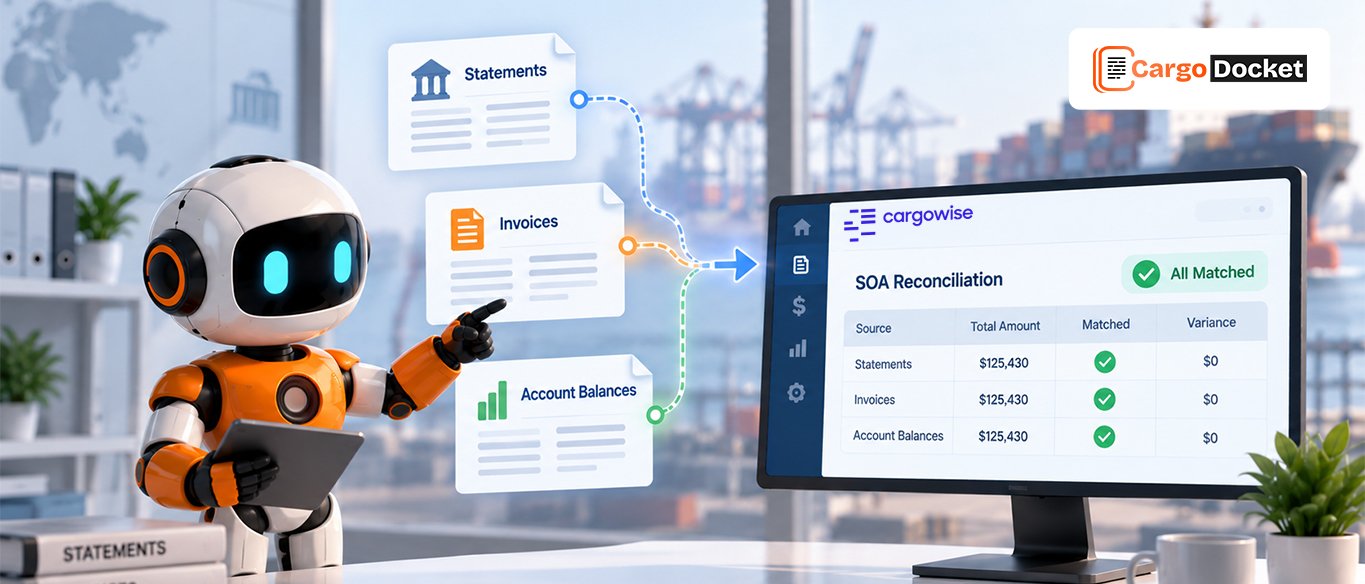
- When invoicing, PO–Invoice and Packing List matching happen instantly, speeding up both AP and AR financial workflows.
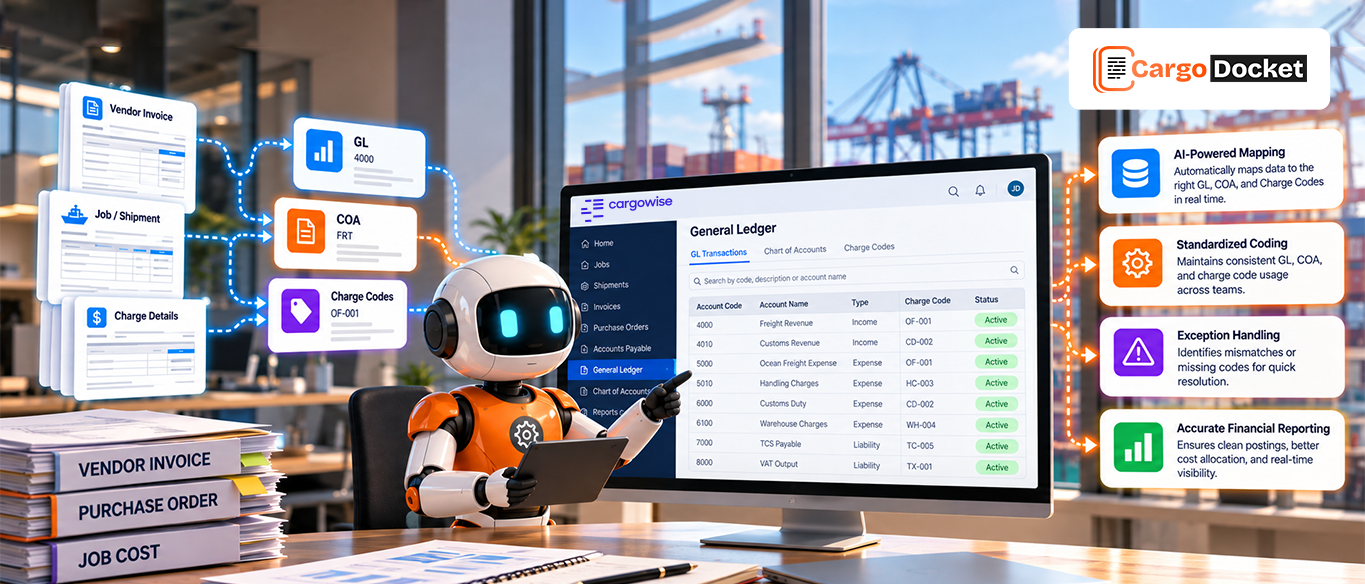
- Finance benefits from automated GL coding and accurate cost allocation, ensuring clean ledgers and audit-ready documentation.
- The end-to-end workflow, from PO to shipment to final invoice, runs smoother, with fewer delays, fewer disputes, and full visibility across departments.
Conclusion
Automating purchase orders removes the manual friction that slows down logistics teams.
With AI handling extraction, validation, approvals, and CargoWise integration, forwarders and supply chain teams gain faster bookings, more accurate shipments, cleaner invoices, and stronger financial control. CargoDocket helps forwarders automate purchase orders end-to-end, from document capture to CargoWise posting, removing manual effort and unlocking data accuracy at scale. If you’re ready to modernize your PO workflow and simplifies your CargoWise environment, let’s schedule a demo and get started today.