
A new RFQ hits your inbox just as you’re trying to finish another quote. Now you need to pull shipment details from the email, dig through carrier rate sheets, check customer pricing, calculate charges, and make sure the margin holds up. Meanwhile, the inbox keeps filling up.
When every quote depends on this manual back-and-forth, responding quickly becomes a challenge, and the delay could cost you an opportunity to win the shipment.
That’s where AI-Driven Quotation Automation can help. It captures RFQ details, brings relevant rates together, and prepares quotes for review and approval, helping your team spend less time on repetitive work and more time responding to customers.
Let’s see where the process slows down and how AI can make quoting easier.
🔍 What Makes RFQ Processing so Time-Consuming for Freight Forwarders?
Preparing a freight quote involves more than just checking a shipment’s origin and destination. You need to understand the customer’s requirements, identify the right service, review applicable rates, and calculate the charges before sending a quotation.
But when this information is spread across emails, attachments, pricing spreadsheets, and customer agreements, your team has to spend time collecting everything before they can even begin preparing the quote.
Common challenges include:
- Scattered shipment information: Details are spread across emails, attachments, and different files.
- Manual data entry: Shipment information needs to be entered again into your quoting system.
- Time spent searching for rates: Carrier rates, agent quotations, and pricing agreements are stored in different locations.
- Pricing inconsistencies: Applying the right charges and margins across multiple quotations can be difficult.
- Increasing RFQ volumes: More requests mean more time spent preparing quotes and less time available for other operational work.
When these steps are handled manually, even a straightforward quotation can take longer than expected.
📥 Where do Incoming RFQs Come From, and How can AI Capture their Details?
RFQs don’t always arrive in the same format. One customer may send shipment details directly in an email, another may attach an Excel sheet, and someone else may share a PDF or send the request through a messaging platform.
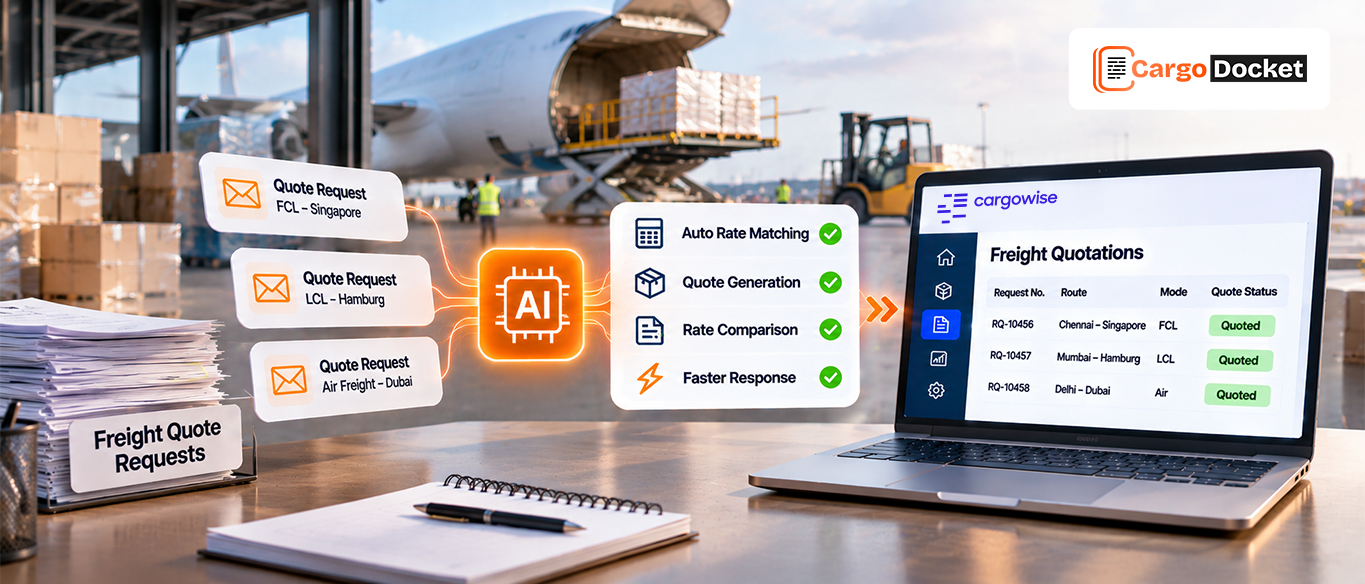
AI can read these incoming requests and capture the information needed to prepare a quotation, including:
- Customer and shipment reference details
- Origin and destination
- Cargo description
- Weight and dimensions
- Number of packages
- Incoterms
- Requested service and shipping requirements
For example, if a customer requests a quotation for two pallets moving from Los Angeles to Sydney, the system can identify the shipment requirements and organize the details for the next step.
If information such as cargo weight, dimensions, or service requirements is missing, it can be flagged for review rather than leaving your team to discover it later in the process.
This gives your team a more organized starting point for every quotation.
💰 How can AI Find the Right Rates and Apply Your Pricing Requirements?
Once the shipment details are captured, the next challenge is finding the right rates and calculating the selling price.
Your team may need to check carrier rates, agent quotations, contract pricing, local charges, fuel surcharges, and customer-specific pricing agreements. When these details are stored across multiple files, comparing them and calculating the final quotation can become time-consuming.
AI-driven quotation workflows can bring relevant pricing information together based on the shipment requirements and your configured pricing rules.
This can help your team work with:
- Carrier and agent rates
- Contract and spot rates
- Freight charges and applicable surcharges
- Customer-specific pricing agreements
- Configured margins and selling rates
Instead of searching through multiple rate sheets for every RFQ, the system can retrieve relevant pricing information and prepare the quotation based on your defined requirements.
Your team can then focus on reviewing the pricing, checking profitability, and making commercial decisions rather than spending most of their time finding and entering rates.
📝 How does AI Automation Turn an Incoming RFQ into a Customer-Ready Quote?
Capturing shipment details and retrieving rates are only part of the process. You still need to turn that information into a quotation, check that everything is correct, get the necessary approval, and send it to the customer.
With AI-driven quotation automation, these steps can follow a structured workflow instead of requiring your team to manually move information between emails, spreadsheets, and CargoWise.
01. Receive the Request
When a customer sends an RFQ through email or a supported channel, the system captures the request along with the relevant shipment and customer details. This gives your team a starting point without having to manually review every incoming request.
02. Capture & Organize Shipment Details
AI reads the RFQ and identifies the required information, such as origin, destination, cargo description, weight, dimensions, package count, and service requirements. The extracted information is organized so it can be used during quotation preparation.
03. Retrieve Rates & Pricing
Based on the shipment requirements, the workflow retrieves relevant carrier or agent rates, applicable charges, and configured customer pricing. This helps bring the information required to calculate the quotation together without repeatedly searching through different rate sheets.
04. Generate the Quote
Once the shipment details and pricing information are available, the system prepares the quotation based on your configured pricing rules, charges, and requirements. This reduces the need to manually calculate and enter quotation details from scratch.
05. Validate the Quote
Before the quotation moves forward, the system checks for missing shipment information, pricing inconsistencies, applicable charges, and configured margin requirements. Any exceptions that need attention can be flagged for review.
06. Request Approval & Send the Quote
Once the quotation is prepared and validated, it is routed to the designated person for approval. The approver can review the shipment details, pricing, charges, and margins before approving the quote. Once approval is received, the quotation can be sent to the customer, and its status can be updated accordingly.
By connecting these steps, you can move an RFQ from the initial request to an approved customer quotation with less manual effort, fewer repetitive tasks, and a more consistent workflow.
✅ What should be Checked Before an Approved Quote Goes Out?
A quotation may be prepared quickly, but it still needs to be accurate. A missing charge, incorrect weight, outdated rate, or wrong margin can affect your profitability and create problems after the shipment is booked.
Before a quote is sent, your team should be able to verify:
- Whether all shipment details are available and accurate
- Whether the applicable carrier rates and surcharges are up to date
- Whether customer-specific pricing requirements have been applied
- Whether the expected margin meets your pricing requirements
- Whether any special customer instructions or service requirements have been missed
AI can help identify missing information, inconsistencies, and pricing exceptions before the quotation moves forward.
If a quote falls outside your configured pricing limits or requires special attention, it can be flagged for review. Your team remains in control of the final pricing decisions and approval process.
👥 Does AI Replace Your Pricing and Operations Team?
No. It changes how your team spends their time.
Instead of manually reading every RFQ, copying shipment details, searching for rates, and preparing quotations from scratch, AI can take care of much of the repetitive work.
Your team can focus on:
- Reviewing pricing exceptions
- Checking margins and profitability
- Handling complex shipment requirements
- Coordinating with customers and carriers
- Making commercial decisions
- Approving quotations before they are sent
The goal isn’t to remove your team’s involvement. It’s to reduce the repetitive work that keeps them from focusing on more important decisions.
🚀 What can Freight Forwarders Gain from AI-Driven Quotation Automation?
When quotation preparation becomes more organized, the benefits go beyond saving time on individual RFQs.
Your team can respond to customers faster, reduce manual data entry, and spend less time searching for rates across different files. With pricing information and shipment details handled through a consistent workflow, you can also improve quotation accuracy and maintain better visibility into margins.
As RFQ volumes increase, your team can manage more requests without every new enquiry adding the same amount of manual work.
That means fewer delays in preparing quotations, a more consistent pricing process, and more time to focus on winning and managing shipments.
📩 Ready to Spend Less Time Preparing Freight Quotes?
Your next RFQ shouldn’t mean another round of searching emails, comparing spreadsheets, and entering shipment details manually.
AI Document Automation can help you read incoming RFQs, organize shipment information, retrieve relevant rates, and prepare customer quotations through an automated CargoWise workflow.
Spend less time preparing quotes and more time responding to your customers.