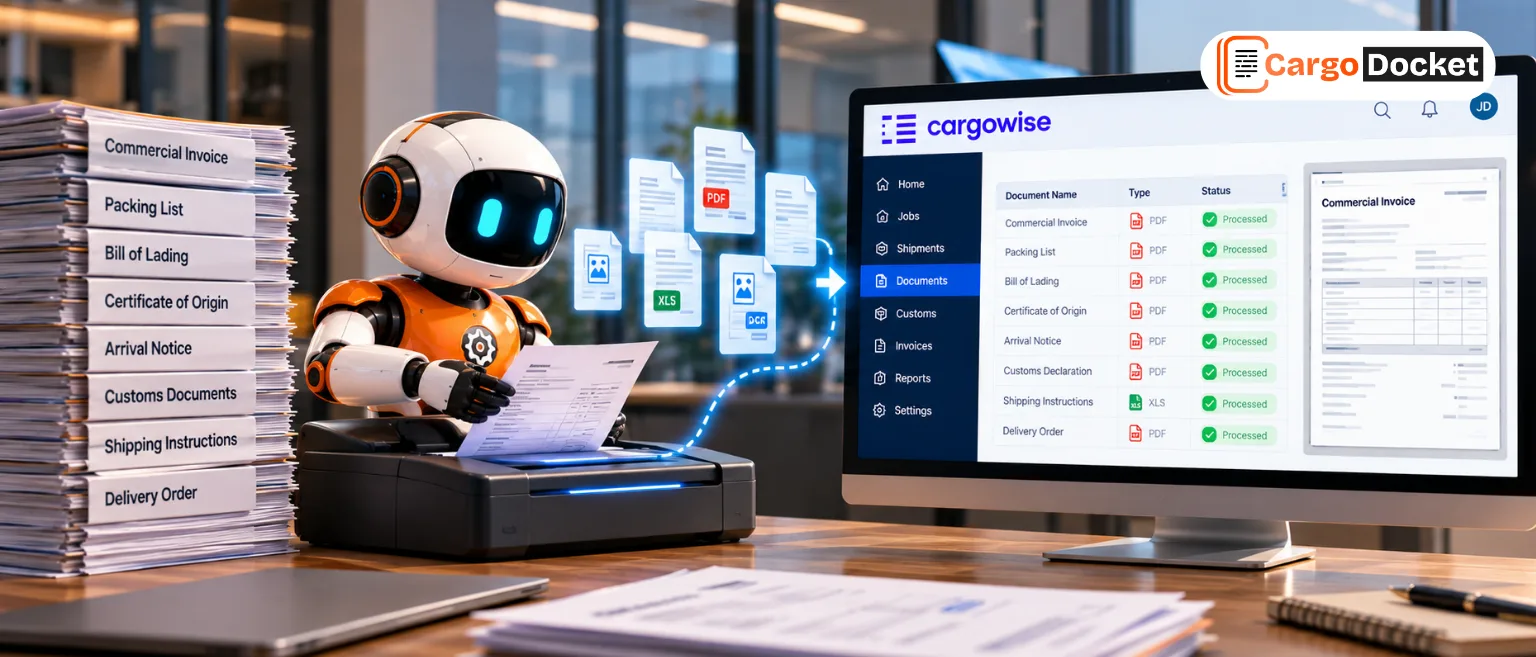

Every logistics document carries valuable business information. A purchase order shows what needs to move, a commercial invoice provides trade details, a booking confirmation drives shipment execution, and an AP invoice connects operations with finance.
But when this information remains locked inside PDFs, emails, spreadsheets, and scanned files, teams spend more time finding answers instead of making decisions.
Cargo Docket AI transforms logistics documents into structured, validated data that helps teams improve visibility, accelerate CargoWise operations, and make faster decisions across the entire freight lifecycle.
The Growing Challenges Behind Modern Freight Documentation
Freight forwarding depends on thousands of information exchanges happening every day.
Every shipment requires accurate details moving between customers, vendors, carriers, finance teams, customs teams, and internal departments.
Common logistics documents include:
- Purchase Orders
- Commercial Invoices
- Booking Confirmations
- Shipping Instructions
- AP Invoices
- Customs Documents
Each document contains important information required for shipment planning, execution, billing, and compliance.
However, many logistics teams still depend on manual processes to capture this information.
Operators open files, identify shipment details, copy data into systems, verify information, and repeat similar steps across different workflows.
As shipment volumes increase, this approach creates challenges because teams are managing documents instead of managing decisions.
A smarter logistics environment requires data to become available when teams need it, not after hours of manual processing.
Why Traditional Document Handling Creates Operational Obstacles?
Logistics documents rarely stay within one department. Information moves through several teams before a shipment process is completed.
A typical information journey includes:
Operations → Documentation → Finance → Customs → Customer Service
Every department depends on accurate information, but traditional workflows often require teams to handle the same data multiple times.
Shipment details may be entered during operations, reviewed by documentation teams, validated during financial processes, and checked again for customer updates.
The same information is repeated:
- Reading logistics documents
- Extracting important information
- Validating shipment and financial data
- Creating structured records
- Connecting information with CargoWise workflows
These repetitive steps create delays, increase manual effort, and make it harder for teams to access information when decisions need to be made.
The challenge is not only the number of documents. The bigger challenge is converting those documents into trusted data that teams can use immediately.
Moving Beyond Manual Work with AI-Powered Logistics Intelligence
Modern logistics businesses are shifting from manual document processing to intelligent operations. The traditional approach sees documents as files that need to be stored and reviewed.
The new approach sees documents as a source of operational intelligence.
For years, manual documentation has created challenges that affect daily freight operations. As shipment and document volumes increase, teams often experience:
- Shipment delays caused by slower document processing
- Invoice mismatches between financial and operational data
- Dependency on operational resources for repetitive activities
- High processing time across documentation workflows
- Reconciliation issues between systems and records
- Lack of real-time visibility into information movement
- Difficulty scaling operations with increasing business demands
Cargo Docket AI understands document information, extracts important details, validates accuracy, and converts it into structured data.
This allows logistics teams to move away from repetitive activities and focus on higher-value work.
Instead of asking:
“Where is this information?”
Teams can focus on:
“What action should we take next?”
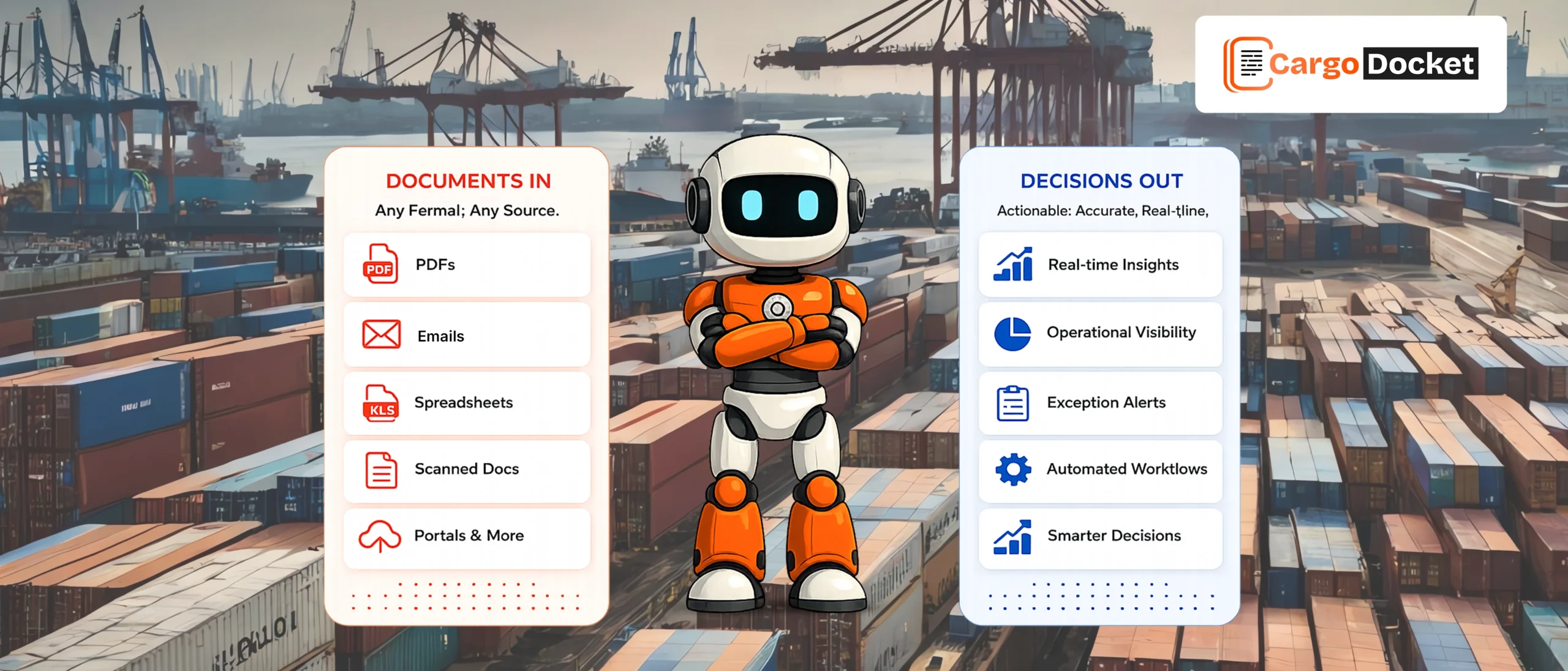
That is the real shift from documents to decisions.
How Cargo Docket AI Turns Information into Actionable CargoWise Data?
Cargo Docket AI is designed to help logistics businesses create a connected flow between documents, systems, and teams.
It reads unstructured logistics documents and converts them into accurate data that supports CargoWise operations.
The platform helps teams:
- Capture document information automatically
- Extract important shipment and financial details
- Validate information accuracy
- Structure data for business workflows
- Connect information with CargoWise processes
The value is not only about reducing manual work. It is about creating reliable data that improves decision-making across operations, finance, customs, and customer service.
Turning Logistics Data into Smarter Business Decisions
Once documents become structured data, logistics teams gain more than automation. They gain better visibility and control over their operations.
Accurate data helps businesses identify problems earlier, respond faster, and make decisions based on real information instead of searching through multiple documents.
For example, operations teams can quickly review shipment information, finance teams can identify invoice differences sooner, and customer service teams can provide updates with greater confidence.
Cargo Docket AI helps convert everyday logistics information into insights that support faster and smarter decisions.
Intelligent Automation Capabilities Transforming Freight Operations
Every logistics process depends on accurate information moving between documents, systems, and teams.
Cargo Docket AI supports multiple areas of automation that help improve freight operations.
Purchase Order Automation
Purchase orders contain essential information that starts many logistics processes.
Cargo Docket AI reads purchase orders and extracts important details such as:
- Supplier information
- Product details
- Quantities
- Shipment instructions
- Delivery references
Validated information can move into operational workflows without repeated manual entry.
Booking Creation Automation
Booking confirmations and shipping instructions provide the foundation for shipment execution.
Cargo Docket AI captures important booking details, including:
- Transport booking information
- Shipment references
- Customer details
- Operational milestones
This helps logistics teams create smoother booking workflows with consistent data.
Shipment Creation Automation
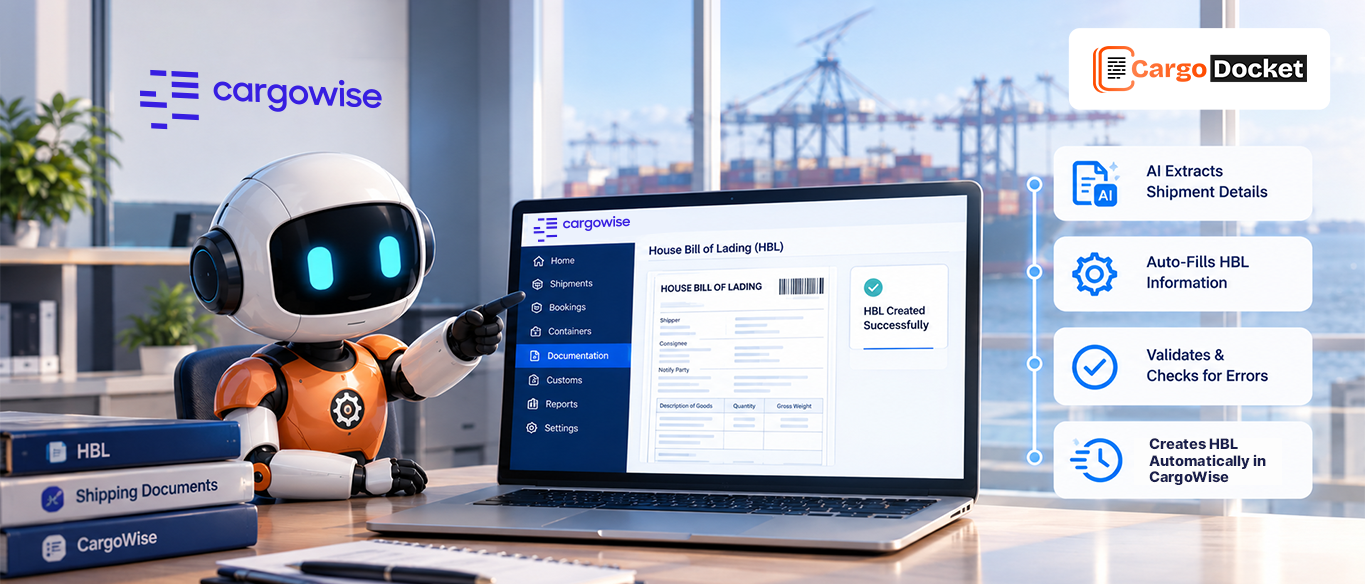
Shipment creation depends on accurate information from multiple sources. Cargo Docket AI extracts and validates shipment data before it moves into CargoWise.
It supports:
- Shipment Jobs
- Transport Jobs
- Warehouse Jobs
With structured information available earlier, teams can improve efficiency and reduce correction work.
Commercial Invoice Automation
Commercial invoices support customs, finance, and reporting processes. Cargo Docket AI converts invoice documents into structured digital information by extracting:
- Invoice numbers
- HS codes
- Product descriptions
- Quantities
- Currency and values
The same information can support multiple workflows without duplicate manual processing.
Accounts Payable Automation
Supplier invoices require careful checking and validation. Cargo Docket AI validates invoice information against CargoWise accruals and operational references.
This helps businesses:
- Detect mismatches earlier
- Reduce reconciliation effort
- Improve AP turnaround time
- Reduce manual intervention
Finance teams gain better control and faster invoice processing.
Vendor Invoice Validation
Vendor invoice processing requires accurate comparison between supplier charges, shipment information, and financial records. Even small differences in invoice details can create additional review work and delay approvals.
Cargo Docket AI helps validate vendor invoices by extracting important invoice data and comparing it with CargoWise accruals and operational references.
The system validates details such as:
- Vendor information
- Invoice numbers and references
- Charge details
- Shipment-related information
- Currency and amount values
By identifying mismatches early, logistics and finance teams can review only the items that need attention instead of manually checking every invoice.
This helps improve invoice accuracy, reduce reconciliation efforts, speed up approvals, and create better visibility across financial workflows.
Building a Smarter Data Journey Across the Logistics Lifecycle
A connected logistics environment depends on how smoothly information moves.
Cargo Docket AI creates a smarter data journey:
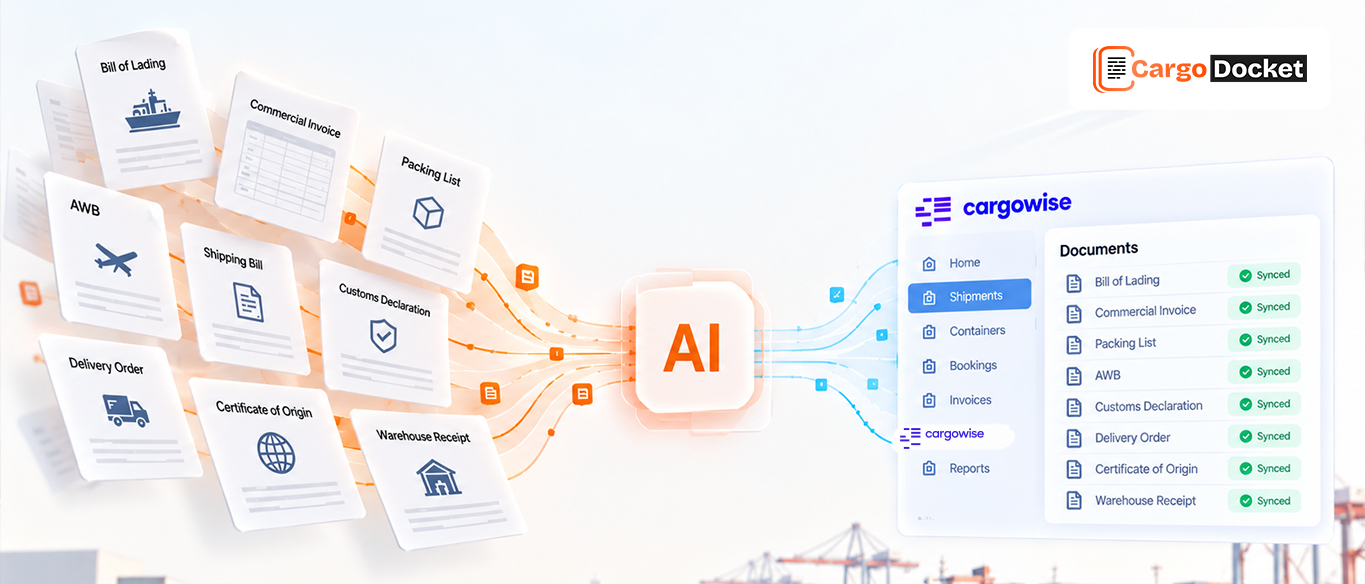
Documents → AI Extraction → Validation → Integration → CargoWise / ERP → Decisions
The platform processes information from:
- Emails
- PDFs
- Excel files
- Scanned documents
- APIs
- Shared folders
After extraction, information is validated and transferred through configured integrations based on business workflow requirements.
When exceptions appear, teams can review and approve information before final processing.
Connecting Teams, Systems, and Decisions through Integrated Data
Modern logistics businesses rely on different systems for operations, finance, customers, and reporting.
Cargo Docket helps create connected data movement across:
- CargoWise
- ERP systems
- WMS systems
- CRM platforms
- Customer portals
- Finance systems (Infor Sunsystem, Xero, QuickBooks, etc.)
Instead of disconnected information, teams gain access to accurate data that supports faster collaboration and decision-making.
Measuring the Impact: Faster Decisions, Accuracy, and Scalable Growth
AI-powered logistics automation improves how teams manage information and operations.
Cargo Docket AI helps businesses achieve:
- Faster processing time
- Improved accuracy
- Reduced operational dependency
- Better visibility
- Faster invoice cycles
- Reduced manual effort
- Scalability without proportional headcount growth
As logistics businesses expand, connected data helps teams manage growth without increasing complexity.
AI Automation Across the Global Logistics Ecosystem
Cargo Docket supports businesses where documentation accuracy and operational efficiency are critical.
Typical use cases include:
- Freight Forwarders
- NVOCCs
- 3PL Providers
- Warehouse Operators
- Customs Brokers
- Shared Service Centers
Each organization may have different workflows, but they share one goal: transforming information into faster action.
Building Future-Ready Logistics Operations with Connected Data
The future of logistics depends on how effectively businesses use information.
Connected data allows teams to improve visibility, strengthen decision-making, and create more efficient operations.
Cargo Docket combines automation, CargoWise connectivity, and logistics intelligence to help businesses move from document-heavy processes to smarter digital operations.
Conclusion:
Documents will always be part of logistics, but manual processing does not have to control operational speed.
Cargo Docket AI transforms documents into structured information that supports CargoWise workflows, improves visibility, and enables smarter decisions.
By moving from documents to decisions, logistics teams can reduce manual effort, improve accuracy, and build scalable operations for the future.Ready to unlock smarter logistics operations? Schedule a call today and discover how Cargo Docket AI can transform your documents into decisions with intelligent automation.