
Every logistics document has a job to do. The challenge is making sure the information inside reaches the right people at the right time.
A shipment doesn’t move with just trucks, ships, or aircraft, it moves with information. Every Bill of Lading, commercial invoice, packing list, customs declaration, and proof of delivery contains details that keep operations moving forward. When those documents are handled manually, even simple tasks like finding information, checking details, or updating systems can take longer than expected.
That’s why more logistics businesses are turning to AI document automation. Instead of treating documents as paperwork, AI transforms them into accurate, structured information that can be shared across operations, helping teams work faster, reduce repetitive tasks, and make better decisions with confidence.
What Exactly is AI Document Automation?
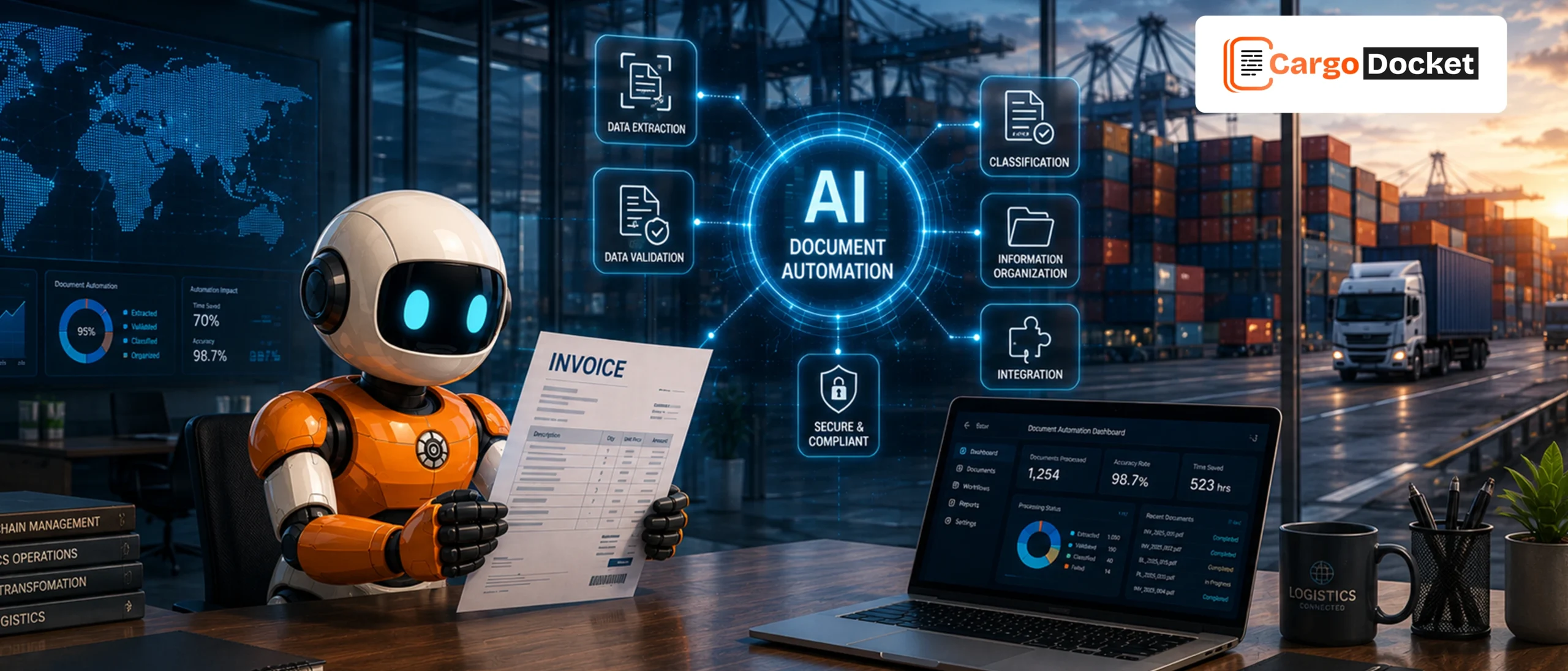
AI document automation is the process of using Artificial Intelligence to capture, understand, organize, and process information from business documents with minimal manual effort.
Unlike traditional document scanning, which simply converts printed text into digital text, AI understands what the document contains. It recognizes different document types, identifies important business information, and prepares that information for operational systems.
Behind the scenes, AI combines several intelligent technologies that work together to improve document processing.
- Artificial Intelligence (AI) recognizes document patterns and understands business information.
- Optical Character Recognition (OCR) converts printed or handwritten text into digital content.
- Intelligent Document Processing (IDP) combines AI and OCR to classify documents, extract important information, validate the data, and organize it automatically.
Instead of treating every document as just another file, AI transforms it into structured business information that is ready for review and operational use.
For logistics businesses, this means teams spend less time opening documents, searching for shipment details, and entering information into multiple systems. Instead, they receive organized information that supports faster decisions and smoother day-to-day operations.
Why are Logistics Documents Becoming More Difficult to Manage?
Logistics has become faster, more connected, and more complex than ever before. Businesses now work with customers, carriers, customs authorities, suppliers, warehouses, and finance teams across different regions, each generating documents that contain important operational information.
A single international shipment can involve commercial invoices, Bills of Lading, packing lists, customs declarations, freight invoices, delivery receipts, and several supporting documents. Every one of these documents contains information that must be reviewed, shared, and updated before the shipment can move to the next stage.
The challenge isn’t collecting documents. The real challenge is processing the information inside them quickly and accurately enough to keep operations moving.
Many logistics businesses still spend valuable time on repetitive activities, such as:
- Reviewing documents one by one.
- Searching for shipment and customer information.
- Entering the same data into multiple systems.
- Comparing information across different documents.
- Correcting missing or inaccurate details.
As shipment volumes continue to increase, these manual activities become more difficult to manage, making it harder for teams to maintain productivity and respond quickly to customers.
This growing complexity is one of the biggest reasons businesses are adopting AI document automation.
Which Logistics Documents Take the Most Time to Process?
Not every logistics document requires the same amount of work. Some are processed in much higher volumes and contain critical business information that teams review repeatedly throughout the day.
These documents often create the biggest manual workload across logistics operations.
Commercial Invoices
Commercial invoices contain product details, shipment values, customer information, tax details, and payment terms. Since invoice formats vary between suppliers, manually reviewing every invoice can become a time-consuming task.
Bills of Lading
Bills of Lading include shipment references, consignee details, carrier information, cargo descriptions, container numbers, and transport instructions. Teams often compare this information with bookings and shipment records before processing can continue.
Packing Lists
Packing lists provide information about package quantities, weights, dimensions, and product descriptions. As shipment volumes increase, reviewing this information manually requires significant time and attention.
Customs Documents
Customs documents contain important shipment information that supports international trade. Missing or incorrect details can create unnecessary delays, making accuracy essential throughout the document process.
Freight Invoices
Freight invoices include transportation charges, supplier information, shipment references, and financial details that finance teams validate before payment processing.
Other important logistics documents, including Purchase Orders, Air Waybills, Arrival Notices, Proof of Delivery, Delivery Receipts, and Certificates of Origin, also require careful review before the information can be used across the business.
The more documents a logistics business processes, the greater the need for a smarter and more consistent way to manage information.
How does Information Travel from a Document to Your Business Systems?
The real purpose of AI document automation isn’t simply to digitize paperwork. Its value comes from transforming information inside documents into structured data that supports everyday logistics operations.
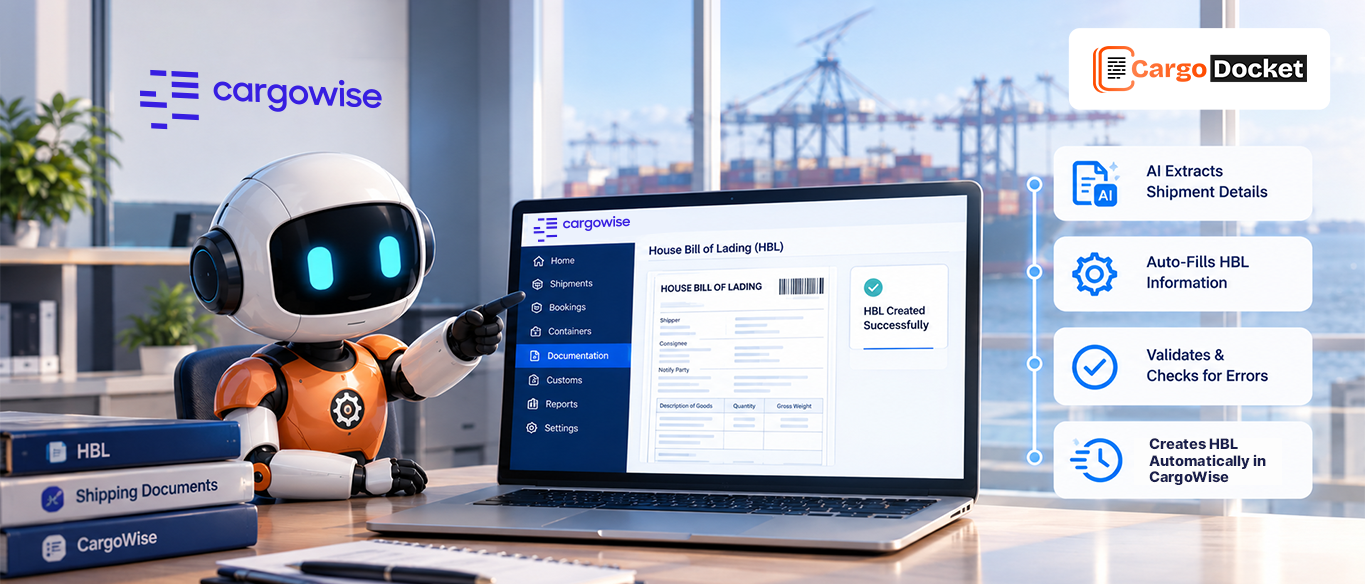
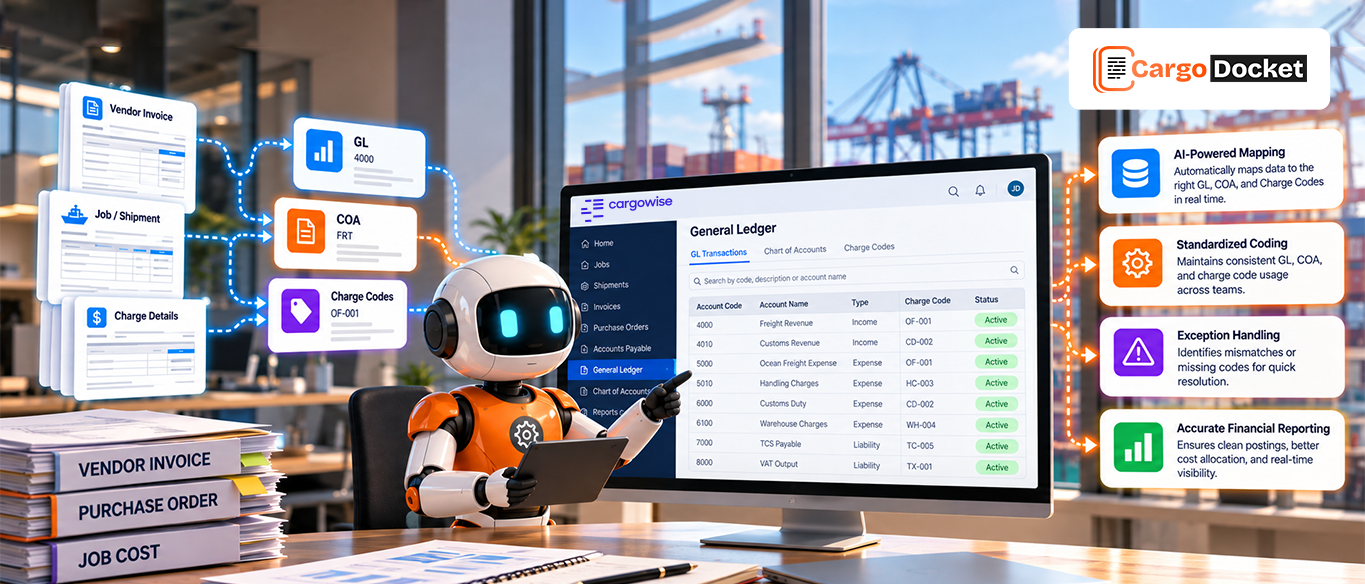
Instead of relying on manual data entry, AI follows a connected workflow that prepares information before it reaches CargoWise.
Receive Documents
AI automatically collects documents from emails, customer portals, shared folders, cloud storage, APIs, and other connected sources, bringing everything into one centralized workflow.
Read and Understand the Document
AI identifies the document type and understands its structure, whether it’s a PDF, scanned image, spreadsheet, or another digital format. Instead of simply reading text, it recognizes the purpose of the information.
Extract Important Information
AI captures key details such as shipment references, customer and supplier information, product descriptions, invoice values, purchase order numbers, and container details, converting them into structured business data.
Organize and Prepare the Data
The extracted information is standardized and organized into a consistent format, making it easier to review, improving data quality, and reducing duplicate entries across business systems.
Validate Business Information
Before processing continues, AI checks the data against business rules, CargoWise master data, and shipment records to identify missing information, duplicate references, or incorrect values early in the process.
Manage Exceptions
If documents contain missing details or inconsistencies, AI automatically flags them for review. This allows teams to focus only on exceptions while the remaining documents continue through the workflow.
Update ERP and Operational Systems
Once approved, the validated information is automatically transferred into CargoWise, reducing manual data entry and ensuring consistent information across operations.
What Changes When AI Becomes Part of Everyday Logistics?
The biggest change isn’t that documents are processed faster. It’s that people no longer spend most of their day working with documents.
Think about how many times your team opens emails, downloads attachments, compares information between invoices and shipment records, or enters the same details into different systems. Individually, these tasks don’t take long, but together they consume hours that could be spent on more valuable work.
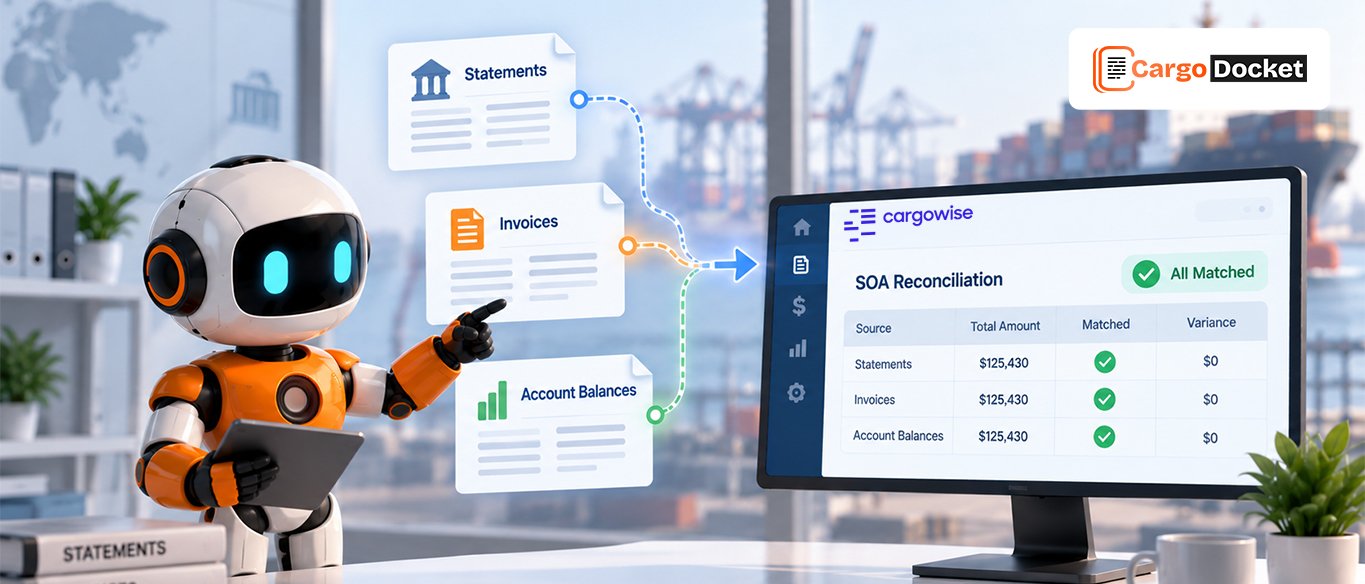
When AI becomes part of the document process, information is available much sooner. Operations teams can prepare shipments without waiting for manual updates, finance teams receive cleaner data for reconciliation, and customer service teams can respond more quickly because the information they need is already available.
As document volumes continue to increase, businesses can handle more work without expanding manual administrative tasks at the same rate. The result is a more connected operation where information moves faster between departments, helping teams make quicker decisions and respond more effectively to customers.
Businesses that adopt AI document automation often experience improvements such as:
- Less time spent on manual document processing.
- More accurate business information.
- Faster access to shipment and financial data.
- Better collaboration between departments.
- Greater visibility into document status and progress.
These improvements don’t just benefit one department, they create a smoother workflow across the entire logistics operation.
Why Human Expertise Still Matters in AI Automation?
While AI is excellent at processing documents, it doesn’t replace the experience and judgment of logistics professionals. Every day, businesses deal with situations that fall outside standard processes. A customer may request a last-minute shipment change, customs requirements may differ between countries, or a supplier might send a document with incomplete information. These are situations where people make a difference.
AI takes care of repetitive activities such as reading documents, extracting information, and identifying inconsistencies. Logistics teams, on the other hand, focus on reviewing exceptions, solving operational challenges, and making decisions that require business knowledge.
The most successful document workflows combine intelligent automation with human expertise. Technology improves speed and consistency, while experienced professionals ensure accuracy, compliance, and customer satisfaction.
How Cargo Docket Helps Businesses Build Smarter AI Document Workflows?
As logistics businesses grow, so does the number of documents moving through the organization. Managing invoices, Bills of Lading, packing lists, customs documents, Proof of Delivery, and freight records manually can quickly become difficult, especially when information needs to reach multiple business systems.
Cargo Docket helps simplify this process by using AI to capture, understand, and organize information from logistics documents before it reaches CargoWise or other connected ERP systems.
Instead of manually reviewing every document, teams receive structured information that is easier to validate and process. The platform also helps identify exceptions, organize extracted data, and prepare business-ready information that supports finance, operations, customs, and customer service teams.
Rather than changing existing workflows, Cargo Docket fits naturally into day-to-day logistics operations, helping businesses reduce repetitive work, improve document accuracy, and manage increasing document volumes with greater confidence.
Conclusion:
Managing logistics documents doesn’t have to be a time-consuming process. With the right automation in place, businesses can process information faster, improve accuracy, and give their teams more time to focus on keeping operations moving.
If you’re looking to simplify your document workflows, contact us to learn how intelligent automation can help improve efficiency, accuracy, and visibility across your logistics operations.