
Every exporter wants faster customs clearance and smoother cross-border trade, yet one document still creates major delays for many logistics teams: the Certificate of Origin (COO).
Studies show that inefficient trade documentation can increase shipment costs by up to 15%, while manual document errors remain a leading cause of customs delays. Even small mistakes in HS codes, origin declarations, or shipment references can lead to shipment holds, rejected FTA claims, or compliance penalties.
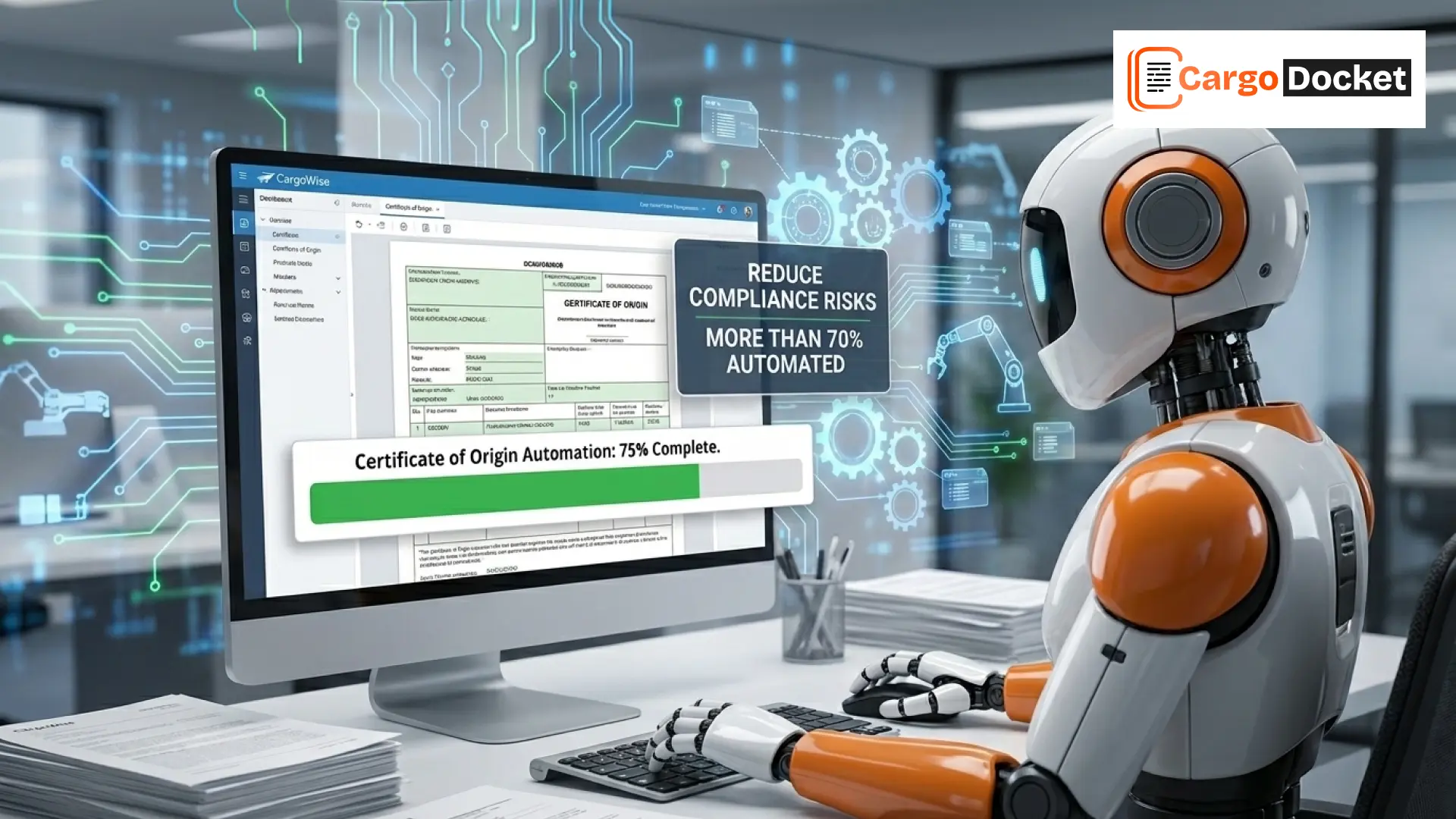
That’s why exporters are turning to AI document automation integrated with CargoWise. Instead of manually reviewing every certificate, automation helps process COO documents faster, reduces compliance risks, and improves control across export workflows.
What is a Certificate of Origin and Why is it Important in Global Trade?
A Certificate of Origin is an official document used in international trade to confirm where goods were manufactured or produced. Customs authorities use it to determine whether shipments qualify for reduced tariffs, trade agreement benefits, or specific import regulations.
For exporters, this document directly impacts customs clearance and trade costs. If the Certificate of Origin is inaccurate or incomplete, importers may lose tariff advantages or face delays at customs checkpoints.
The document typically includes:
- Exporter and importer information
- Product descriptions
- HS codes and origin declarations
- Country of manufacture
- Trade agreement references
In modern logistics operations, the Certificate of Origin is not just a compliance document, it is a financial and operational requirement that affects how quickly and cost-effectively goods move across borders.
What Challenges do Exporters Face with Manual Certificate of Origin Processing?
Most exporters still process Certificates of Origin manually, especially when handling multiple countries, suppliers, and trade agreements. While this process may seem manageable at smaller volumes, it quickly becomes difficult to scale.
Teams often receive documents in PDFs, scans, spreadsheets, or email attachments. Every document must be reviewed manually before the information is entered into CargoWise or customs systems.
This creates several operational challenges.
Common problems exporters face:
- Inconsistent document formats from suppliers and partners
- Manual validation of HS codes and trade rules
- Missing or incorrect origin declarations
- Delays caused by repeated document reviews
- Difficulty tracking compliance across multiple trade agreements
The biggest issue is that manual processes create reactive workflows. Teams spend more time correcting errors and managing exceptions than actually supporting shipment execution.
As shipment volumes increase, these problems become more visible.
What Happens When Certificate of Origin Processing is Automated?
Automation changes the workflow from manual document handling to intelligent data processing.
Instead of manually reviewing every Certificate of Origin, AI document automation captures incoming files, extracts the required data, validates compliance fields, and prepares the information for CargoWise automatically.
The process becomes faster, more accurate, and easier to control.
What automation improves immediately:
- Faster extraction of trade document data
- Automated validation of HS codes and shipment references
- Reduced manual data entry and document review
- Standardized formatting across export workflows
- Faster customs preparation and submission
More importantly, automation shifts teams away from repetitive tasks and allows them to focus on compliance monitoring and exception handling.
How does CargoWise Integration Improve Certificate of Origin Automation?
CargoWise acts as the operational core for many global logistics organizations. It stores shipment details, customer records, product information, and financial data that are essential for export compliance.
When Certificate of Origin automation is integrated with CargoWise, the workflow becomes significantly more reliable.
Instead of manually matching certificate data against shipment records, automation validates information directly against CargoWise data before submission. This ensures that shipment references, HS codes, customer details, and trade information remain aligned across systems.
This creates several advantages for exporters:
- Shipment and compliance data stay synchronized
- Customs declarations become more accurate
- Manual reconciliation work is reduced
- Export documentation becomes easier to track and audit
The result is not just faster document handling, but cleaner and more dependable export workflows.
How Cargo Docket Helps Automate Certificate of Origin Processing?
Cargo Docket AI is designed specifically for logistics and trade documentation workflows. Instead of treating Certificates of Origin as standalone files, the platform connects them directly with operational data inside CargoWise.
The system automatically captures incoming COO documents from emails, uploads, or integrated systems. AI then extracts important trade information such as exporter details, origin declarations, HS codes, and shipment references.
But the real value comes from validation.
Cargo Docket cross-checks extracted information against CargoWise shipment records and compliance rules before processing the document further. This reduces the risk of incorrect declarations or missing data reaching customs authorities.
Key capabilities of Cargo Docket AI:
- AI-powered document extraction from PDFs and scans
- Validation of trade and shipment references
- Automated synchronization with CargoWise
- Standardized export document formatting
- AI exception handling for incomplete or inconsistent data
Instead of requiring teams to manually review every document, Cargo Docket allows operations and compliance teams to focus only on flagged exceptions.
This creates a far more scalable and controlled export workflow.
What Changes for Exporters After Certificate of Origin Automation?
Global trade is becoming more complex every year. Exporters are managing higher shipment volumes, stricter compliance requirements, and increasing pressure to move goods faster across borders.
Manual Certificate of Origin processing struggles to keep pace with this complexity.
As shipment volumes grow, teams spend more time validating documents, correcting errors, and managing customs delays. This not only slows operations but also increases operational risk.
Without automation:
- Errors increase as shipment volumes grow
- Compliance risks become harder to manage
- Customs delays impact delivery timelines
- Teams spend excessive time on repetitive document handling
With automation, the workflow changes completely.
- Documentation becomes standardized and easier to process
- Compliance validation happens automatically
- Export workflows become scalable across multiple regions
- AI exception handling identifies issues before submission
- Customs processing becomes faster and more predictable
This shift allows exporters to move from reactive document management to proactive compliance operations.
How does AI Document Automation Reduce Compliance Risks?
Compliance risks in international trade often come from inconsistent or inaccurate data. A missing HS code, an incorrect country of origin declaration, or a mismatch between invoice and shipment records can trigger customs reviews or penalties.
AI document automation reduces these risks by validating information before documents are submitted.
The system continuously checks:
- Shipment references
- Trade agreement conditions
- Product classifications
- Origin requirements
- Missing or inconsistent fields
Instead of identifying errors after submission, exporters can resolve issues before customs processing even begins.
This reduces delays, improves audit readiness, and strengthens confidence in export documentation.
What Changes for Exporters After Certificate of Origin Automation?
Global trade is becoming more complex every year. Exporters are managing higher shipment volumes, stricter compliance requirements, and growing documentation pressure across multiple countries and trade agreements.
Manual Certificate of Origin processing struggles to keep pace with this complexity. As shipment volumes increase, teams spend more time validating documents, correcting errors, and managing customs delays.
Without automation:
- Errors increase as shipment volume grows
- Compliance risks become harder to control
- Customs delays impact delivery timelines
- Teams spend excessive time on repetitive document handling
With automation, the workflow becomes faster and more structured.
- Documentation becomes standardized
- Compliance validation happens automatically
- Export workflows become scalable
- Customs processing becomes more predictable
This shift allows exporters to move from reactive document handling to proactive compliance management, which is becoming essential in modern global trade operations.
Conclusion:
Certificate of Origin processing sits at the center of global trade compliance. When handled manually, it introduces delays, inconsistencies, and operational risk across export workflows.
By combining AI document automation with CargoWise integration, exporters can process COO documents faster, reduce errors, and create a more scalable and reliable compliance workflow. If your team is still manually processing Certificates of Origin, now is the time to explore how Cargo Docket AI can simplify compliance, improve accuracy, and accelerate your global export operations. Contact us today to discover how automation can simplify your Certificate of Origin workflows and enhance export efficiency.