
What if the biggest reason for customs delays isn’t the shipment itself but the time spent preparing the documents behind it? Every international shipment depends on accurate customs documentation. Commercial Invoices, Packing Lists, Bills of Lading, Customs Declarations, Certificates of Origin, and other supporting documents all play a critical role in customs clearance. As global trade grows and compliance requirements become more complex, customs teams are handling more documents than ever before.
To keep freight moving efficiently, many logistics businesses are using AI to simplify document processing, reduce repetitive manual work, and help customs professionals focus on compliance instead of paperwork.
📑 Every Customs Clearance Depends on Documents that Tell the Same Story
Every customs document has a different purpose, but together they tell the complete story of a shipment.
Before a customs declaration is submitted, customs teams must ensure that information remains accurate and consistent across multiple customs clearance documents, including:
- Commercial Invoice
- Packing List
- Bill of Lading (B/L)
- Certificate of Origin
- Customs Declaration
- HS Code Information
- Import or Export Permits
- Supporting Compliance Documents
These documents are often created by different parties throughout the supply chain. Suppliers prepare commercial invoices, freight forwarders issue transport documents, customers provide purchase information, and customs brokers compile everything for customs submission.
Even a small inconsistency, such as a different product description, an incorrect shipment value, a missing HS Code, or a quantity mismatch, can create additional customs reviews and delay cargo release. As shipment volumes continue to increase, manually reviewing every document while maintaining complete accuracy becomes increasingly difficult for customs teams.
🌍 Customs Teams are Under More Pressure than Ever Before
Customs clearance has become much more than preparing declarations. Today’s customs professionals review shipment information, validate invoice values, confirm tariff classifications, verify supporting documents, and ensure every shipment complies with country-specific regulations before it reaches the border.
As international trade expands, these responsibilities continue to grow. Customs teams often spend valuable hours reading documents, comparing shipment information, validating data, and manually entering information into customs software before they can even begin the compliance review.
For logistics leaders, the challenge is not replacing experienced customs professionals. The challenge is helping them spend less time on repetitive document processing and more time managing compliance, resolving shipment exceptions, and keeping international freight moving efficiently.
🤖 How AI Creates a Smarter Customs Document Workflow?
Preparing customs documents manually often means opening multiple files, searching for shipment details, comparing information, and entering the same data into customs software. While these tasks are essential, they consume valuable time and increase the risk of delays as shipment volumes continue to grow.
AI simplifies this process by creating a connected workflow that organizes, validates, and prepares customs documents before they reach customs professionals for final review.
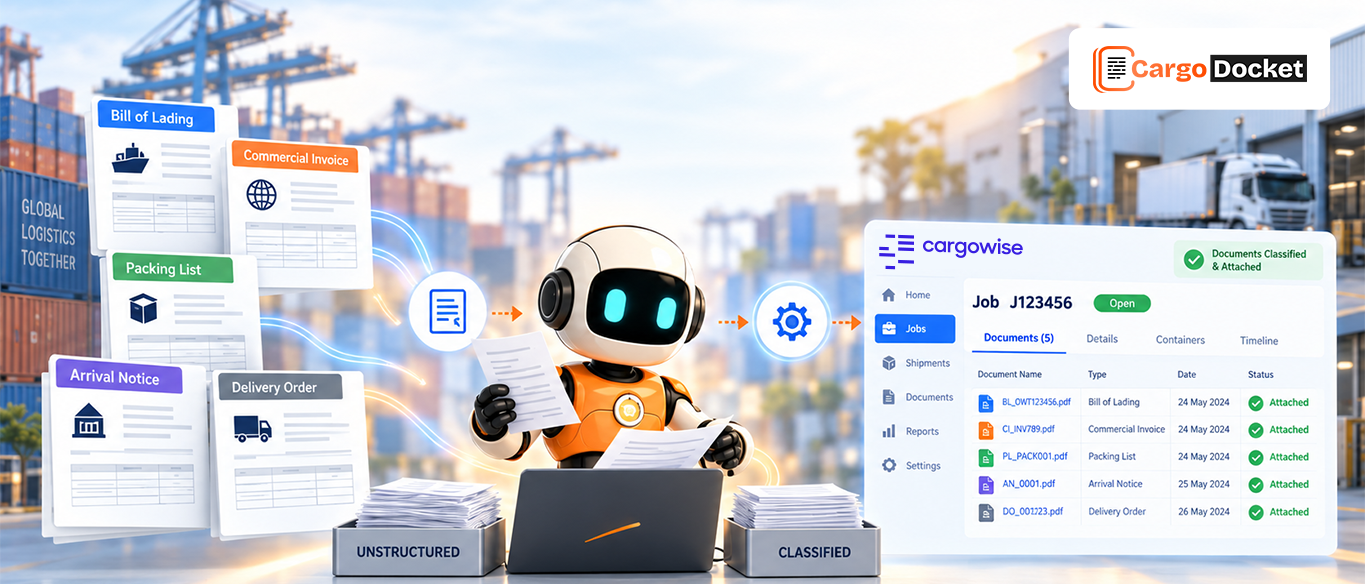
📥 Receive Customs Documents
Customs documents, shipment files, and supporting trade documents are automatically collected from emails, customer portals, scanners, or connected systems into one centralized workspace. This removes the need for teams to search across multiple locations before processing begins.
📄 Read & Extract Shipment Information
AI reads customs clearance documents such as Commercial Invoices, Packing Lists, Bills of Lading, Certificates of Origin, Customs Declarations, and other supporting documents. It automatically captures important shipment information, including consignee details, cargo descriptions, invoice values, HS Codes, shipment references, quantities, and ports.
🔄 Map and Organize Customs Data
Once the information is extracted, AI maps the data into the correct customs fields and converts it into the format required for customs software or connected logistics systems. This helps ensure consistency while reducing repetitive manual data entry.
✅ Validate Shipment Data & Flag Exceptions
Before customs declarations are prepared, AI compares information across multiple documents to identify missing fields, value mismatches, incorrect HS Codes, duplicate records, or inconsistent shipment information. Instead of manually checking every document, customs teams can focus only on the shipments that require attention.
👨💼 Review & Manage Exceptions
Customs professionals review the highlighted exceptions in the dashboard, make any required corrections, and approve the validated shipment information before it moves forward. This keeps people in control while significantly reducing repetitive document handling.
🚀 Send Validated Data to Customs Software or ERP
After approval, the validated shipment information is automatically transferred into customs software, CargoWise, or other connected ERP systems. With structured and accurate data ready for use, customs teams can prepare declarations faster, improve compliance, and keep shipments moving across borders with greater confidence.
📊 Better Document Processing Leads to Better Customs Decisions
The biggest benefit of AI is not simply processing documents faster. It is giving customs professionals more time to focus on compliance, regulatory reviews, shipment exceptions, and customer communication instead of repetitive data entry.
When customs information is captured, validated, and organized before declarations are prepared, businesses reduce document corrections, improve collaboration between customs and operations teams, and gain better visibility across the clearance process. Teams can identify issues earlier, respond to exceptions faster, and improve the overall quality of customs submissions before they reach government authorities.
As shipment volumes continue to increase, this approach helps logistics businesses improve operational efficiency while maintaining the accuracy and compliance that international trade demands.
📈 Smarter Customs Document Processing Supports Stronger Logistics Operations
The value of AI extends well beyond preparing customs documents. When customs information is captured and validated earlier in the shipment lifecycle, logistics businesses gain stronger operational control. Customs teams can process documents more consistently, operations teams receive faster shipment updates, and customers benefit from improved communication throughout the clearance process.
Better document workflows also help reduce clearance delays, improve audit readiness, strengthen compliance, and create greater confidence across the entire supply chain. Rather than reacting to documentation issues at the last minute, businesses can proactively resolve them before they affect shipment movement.
For logistics leaders, investing in better document processing is not simply about improving efficiency. It is about building a more reliable customs operation that supports long-term business growth.
🚀 Final Thoughts
Accurate documents are the foundation of faster customs clearance. As shipment volumes continue to grow, relying on manual document processing makes it harder to maintain speed, accuracy, and compliance.
With AI Document Automation, logistics businesses can automatically capture customs documents, extract shipment information, validate critical data, identify exceptions, and prepare customs workflows with greater efficiency. This allows customs professionals to spend less time processing paperwork and more time making informed compliance decisions that keep freight moving across borders.
The future of customs clearance is not about replacing people with technology. It is about giving customs teams smarter tools to work faster, improve document accuracy, and keep global trade moving with confidence.