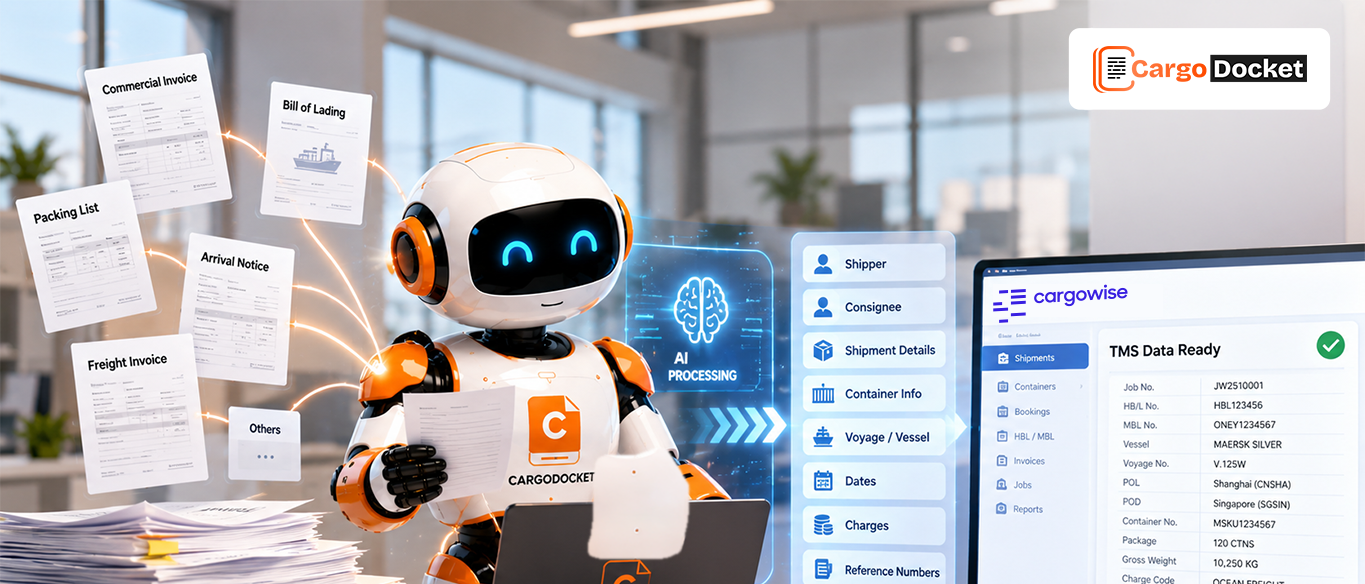

Think about your last busy day in operations or finance. Emails stacked up with invoices, BOLs, packing lists, and AWBs, all waiting to be checked, validated, and entered into CargoWise. Nothing moves forward until the documents are right.
Now here’s the real question:
Are your shipments slowing down because of transportation or because of documentation?
Speed, precision, and visibility are more important than ever in the modern logistics environment. However, when teams spend hours reading and retyping documents, errors increase, delays occur, and systems such as CargoWise do not work optimally.
That’s where AI document automation changes everything. Instead of manually handling documents, AI reads, validates, and pushes clean data directly into your system, turning documentation from a bottleneck into a driver of efficiency.
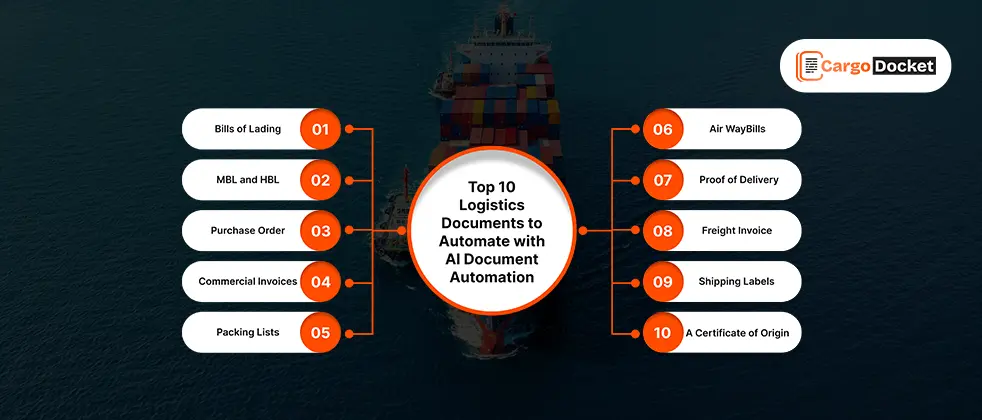
Let’s break down the top 10 logistics documents you should automate and why each one matters in your workflow.
Why Document Automation is Important for Freight Forwarders?
Every logistics workflow follows a pattern: Order → Shipment → Documentation → Invoice → Payment.
Documents sit at the center of this flow. If they are delayed or incorrect, everything downstream slows down, including bookings, customs clearance, invoicing, and even cash flow.
Automation ensures that every document entering your system is:
- Clean and structured
- Validated against shipment data
- Ready to move forward without manual correction
Now let’s look at the documents that create the biggest impact.
1. Bills of Lading (BOL)
The Bill of Lading is one of the most critical documents in freight. It connects the shipper, consignee, cargo details, routing, and carrier responsibilities.
In manual workflows, teams often spend significant time extracting details like container numbers, ports, and cargo descriptions. Any mismatch between BOL data and shipment records can cause booking issues or customs delays.
With AI automation, BOL data is captured instantly and validated against system records. This ensures:
- Accurate shipment creation in CargoWise
- Correct routing and container details
- Fewer corrections during customs processing
When BOLs are automated, the entire shipment process becomes smoother and faster.
2. Master Bill of Lading (MBL) and House Bill of Lading (HBL)
MBL and HBL documents are critical in freight forwarding, especially for consolidation. Teams often spend time matching multiple HBLs with a single MBL, checking shipment details, and ensuring consistency.
With automation, data from both MBL and HBL is captured and validated instantly, helping teams:
- Avoid mismatches between documents
- Create accurate consolidations
- Reduce manual reconciliation work
This is especially useful for high-volume import and export operations.
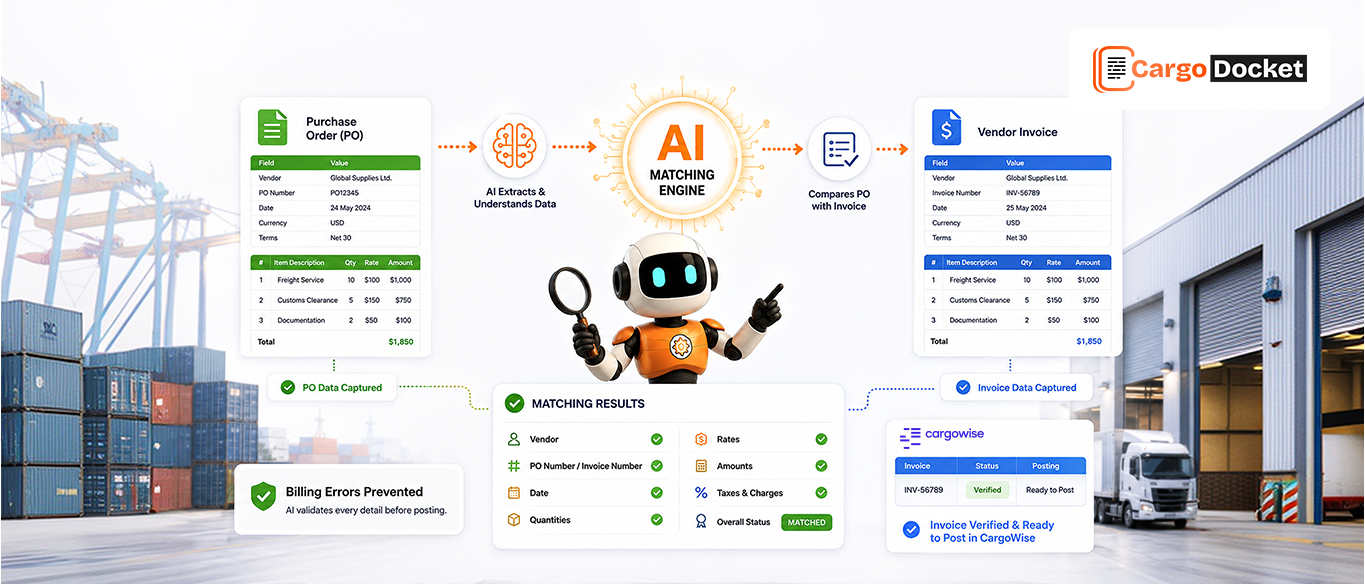
3. Purchase Orders (PO)
Purchase Orders are the starting point of the logistics lifecycle. They define what is being shipped, in what quantity, and under what terms.
Errors in POs don’t stay isolated. They flow into bookings, shipments, invoices, and financial records.
AI automation ensures PO data is clean from the beginning by:
- Extracting product details, pricing, and quantities
- Validating supplier and buyer information
- Aligning PO data with shipment planning
When POs are accurate, the entire workflow becomes more predictable and efficient.
4. Commercial Invoices
Commercial invoices play a key role in customs clearance and international trade compliance. They include product descriptions, values, HS codes, and country of origin.
Manual processing often leads to vague descriptions or incorrect classifications, which can delay clearance or trigger penalties.
Automation improves this by:
- Extracting detailed product information
- Validating HS codes and values
- Ensuring consistency with shipment and PO data
This reduces compliance risks and speeds up customs processing.
5. Packing Lists
Packing lists provide detailed cargo information such as quantities, packaging types, and weights.
These details must match both the shipment records and commercial invoices. Any inconsistency can create confusion at warehouses or customs checkpoints.
With automation:
- Packing data is extracted instantly
- Quantities and weights are validated
- Data aligns with other shipment documents
This improves warehouse planning and ensures smoother cargo handling.
6. Air Waybills (AWB)
Air Waybills are essential for air freight operations. They include flight details, cargo weight, routing, and consignee information.
Manual AWB processing slows down operations, especially when handling high shipment volumes.
AI automation allows:
- Instant extraction of AWB data
- Accurate entry into CargoWise
- Faster air shipment processing
This improves turnaround time and reduces errors in air freight workflows.
7. Proof of Delivery (POD)
Proof of Delivery confirms that shipments have reached their destination. These documents are often scanned or handwritten, making them difficult to process manually.
Automation helps by:
- Digitizing PODs instantly
- Extracting delivery confirmation details
- Making data available in real time
This improves customer visibility and reduces disputes.
8. Freight Invoices
Freight invoices include detailed cost breakdowns such as transportation charges, surcharges, and handling fees.
Manual validation requires cross-checking rates and shipment details, which takes time and increases the risk of overpayments.
Automation ensures:
- Accurate extraction of cost data
- Matching with agreed rates
- Faster financial reconciliation
This strengthens financial control and reduces revenue leakage.
9. Shipping Labels
Shipping labels carry routing and tracking information that directly affects delivery accuracy.
Errors in labels can lead to misrouted shipments and delays.
With automation:
- Label data is captured and validated
- Routing information is verified
- Shipment tracking becomes more reliable
This ensures smoother last-mile delivery.
10. Certificate of Origin
Certificates of Origin are essential for international trade and determine duty rates and trade agreements.
Manual handling of these documents increases compliance risks.
Automation ensures:
- Accurate extraction of origin details
- Alignment with shipment and invoice data
- Faster document submission
This reduces delays and ensures compliance with global trade regulations.
How do these Documents Connect in a Single Workflow?
Each of these documents is not isolated. They are part of a connected process.
- A Purchase Order feeds into shipment creation.
- The shipment generates a Bill of Lading and Packing List.
- Commercial invoices and certificates support customs clearance.
- Freight invoices and AP invoices drive financial workflows.
- Proof of Delivery closes the loop.
When even one document is delayed or incorrect, the entire chain is affected.
AI document automation connects all these documents into a single, clean workflow where data flows consistently across systems like CargoWise.
Conclusion
Logistics success is no longer measured only by how quickly you can transport cargo. It is determined by how effectively you manage the data underlying each shipment.
The documents described above form the foundation of every logistics operation. When handled manually, they result in delays, errors, and inefficiencies. When automated, they maximize speed, accuracy, and scalability throughout your operation.
If your team continues to spend hours processing paperwork, you are losing more than simply time; you are also losing operational efficiency.
AI document automation gives you control, visibility, and speed where it matters most. Ready to transform your freight documentation workflow? Book a demo and see how automation can simplify your operations and improve your CargoWise performance.